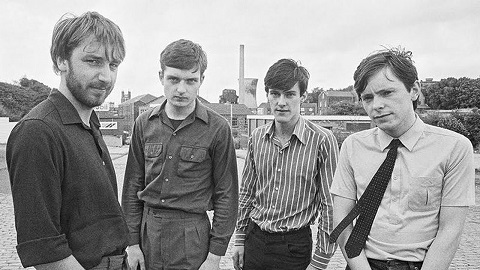
Manchester, so said one of its greatest champions Tony Wilson, was a one of the most important cities in the world, thanks to it being at the heart of the industrial revolution, and its cultural contribution that rose from a grimy, concrete landscape to become such an inspiration to millions. One band Wilson was involved with was Joy Division, consisting of four Manchester lads who in the late nineteen-seventies were provoked by a Sex Pistols concert in the city to form their own band. But while the Pistols were living the punk dream, Joy Division sounded as if they were trapped in a nightmare: there was nothing exuberant about their music, no joy at all...
The spectre of early death looms large over director Grant Gee and his writer Jon Savage's telling of the story of this groundbreaking post-punk band, as everyone who knows of them, and presumably everyone who sits down with enough interest to watch this, will be well aware of why they were forced to regroup in 1980. It’s part of the legend, as it is with many musicians and singers who left this world prematurely, and there's a real danger of romanticising anyone from Hank Williams to Jimi Hendrix to Janis Joplin to Sid Vicious to Kurt Cobain to Amy Winehouse, and that's barely scratching the surface of one of what must be one of the most dangerous professions for the young.
But Ian Curtis was different to those mentioned above: he deliberately took his own life, thanks to the anxiety his circumstances were bringing him, the epilepsy he had been afflicted with and his fracturing marriage among them. Then there was the pressure of fame: he was due to join the band on an American tour the following day, and it's no wonder they felt a weird anger with him, as they say here. That was what made this documentary important, for Gee got the three survivors before his camera to have the final word on their output of that era, something they had by no means been happy to discuss over the course of the previous thirty years or so, and just as well.
This was because there really is hardly any footage of Joy Division left, not that there was much at the time, so the occasional television appearance and amateur concert footage clips are all that really remain; there's certainly no footage of Curtis being interviewed, a radio chat is all that there is. Gee did his best to string this out as far as he could, but some carefully selected footage of Manchester, then and now (for 2007), as well as the talking heads that are heard throughout, did allow what could have been a dutiful plod through a depressing and oft-related story a cumulative power. By the end, simply by hearing the mixture of the mournful music and the testimonies of those who carried on while Curtis did not, you may find yourself unexpectedly moved, whether you know all the details or not.
Of course that music should be the most important element, it is Joy Division's legacy, but the most telling aspect comes when the interviewees admit they never really listened to Curtis's lyrics, and when they did after he had died, they were shocked to realise this is what he was singing about: desolation, death and depression. His widow Deborah refused to take part, but extracts from her book were allowed, and she observes that when he was not performing or working (he had a job at a benefits office helping with the disabled) he was reading obsessively about human suffering. This is why the band was named after the women forced into Nazi brothels, and though his friends emphasise he did like a laugh, Curtis's increasingly darker thoughts and opinions, often of a right-wing nature, are glossed over here, though they fed into the bleakness of his art. Wilson, who died before the film was released, remained optimistic for Manchester, it would weather its storms and emerge over and over as a positive force, but if Joy Division was a positive force, well, maybe that's not too clear. Weirdly, success is not always entirely good for you.