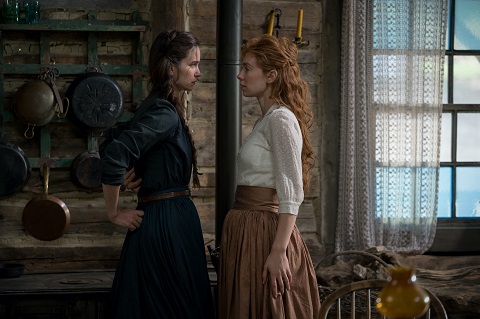
The year was 1856, and Abigail (Katherine Waterston), in the American North-East, was struggling. Her marriage to farmer Dyer (Casey Affleck) had soured into a sense of pointlessness and lack of direction, ever since their young daughter had died. This seismic event had crushed them both, but Abigail in particular, and she could barely face even going to bed with her husband, never mind creating a new baby with him. It seemed as the harsh winter of the start of that year truly began to bite, there would be nothing to life her out of her doldrums, and Dyer had no idea of how to treat his wife's depression...
But then someone else entered her life, someone she could call a new friend, Tallie (Vanessa Kirby) - someone she could call a lover. The trouble with The World to Come is that you can more or less tell the way it will play out from the first few minutes. A lesbian drama from the time when nobody spoke the word "gay", probably because it did not mean the same thing as it did now back then, but nevertheless, the point holds, if you had ever seen something like this before, you would be well aware the society depicted would not allow the briefly happy couple to enjoy lasting happiness. Therefore no matter how well played it was, no matter the attractiveness of the scenery and the intricacy of the production design to get every little detail just right, you were not going to watch this to be uplifted.
And sad to say this was a state of affairs (no pun intended) that had been established for decades in the genre. You could observe that Kirby's bright performance was all the more powerful for being set in a miseryfest, so her character's scintillating personality not only lightened the burden of life on Abigail, but we wanted to see more of her too, anything to pierce the deadening gloom. Certainly, while Waterston was putting in her usual reading with her utmost professionalism, as you would expect if you knew her work, if anything she was too convincing at conveying the desolation Abigail was being steamrollered under, to the extent that it was painful to watch any attempt to potentially lighten her load cast aside by her husband.
Or by the patriarchal community that insisted women were not put on this Earth to enjoy themselves, they were here to partner men and bear them children. If they cannot do that, what use are they? That's the question Abigail finds herself asking, but then Tallie makes her see a new path through this vale of tears where it is not sinful to pursue personal satisfaction and pleasure, as long as you are not doing any harm, and indeed are cheering someone else up in the process. At this stage what a revolutionary lesbian story would do would be to have Abigail and Tallie announce "'K bye" to Dyer and Tallie's husband Finney (Christopher Abbott portraying the absolute worst of the patriarchy's attitudes) and head off on their own for an existence of contentment.
Knowing, and this was crucial, that they were with someone who appreciated them. There must have been women who did that in the nineteenth century, but in the film versions all we hear about them is the downsides, obviously you cannot ignore the prejudices, but a show of strength from a relationship that seems to boost each of the participants would not have gone amiss. Alas, writers Jim Shepherd and Ron Hansen seemed as keen to punish the two ladies as Finney is, so despite a woman directing - Mona Fastvold, hitherto known as a writer on Brady Corbet films - it did come across as a very male-centric view on a subject that needed a new perspective. Or at least a happier outcome that went past the lesbian drama that from The Children's Hour to The Killing of Sister George had been a conduit for female neurosis rather than eventual contentment. Kirby was the best reason to watch, a gem. Music by Daniel Blumberg.
[Sony Pictures UK presents THE WORLD TO COME, starring Katherine Waterston, Vanessa Kirby, Christopher Abbott and Casey Affleck, and directed by Mona Fastvold, which comes to UK cinemas on Friday, July 23 2021.]