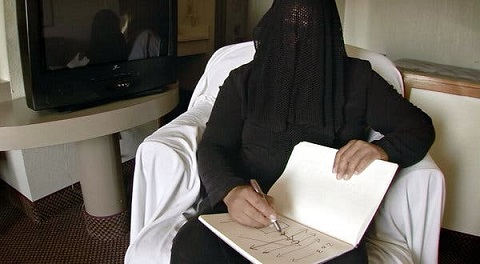
This man used to be a sicario, that is a hitman for a Mexican drug cartel. He is interviewed in one of the motel rooms where he used to conduct his business, that business being torture and murder in return for a handsome fee and access to many perks. Because he has now left the criminal way of life, he does not want to be identified, so places a black cloth over his head to disguise his identity - appropriately, it resembles a funeral veil or shroud. He then sits down with a pad and pen and begins...
Gianfranco Rosi became renowned in the documentary world for his daring in choosing his socially relevant subjects, as well as the matter of fact manner he went about recording them: there would be very little in the way of sensationalism in his work, and so it was here, basically a man sitting in a room relating his life story. He had the paper and pen to help illustrate his tales, which he did with artless directness, more or less stick men and the crudest realisations imaginable, though they did the job.
Besides, it was what the anonymous man described that was important: there were no photographs of crime scenes, or documentary footage of the victims, it was as simple as could be without being a radio broadcast or podcast. He did not come across as particularly evil in personality, almost unassuming in demeanour yet as the horror of what he was talking about quickly sank in, it was undeniably something you did not want to hear, but also something you felt you should be aware of that he discussed in his monologue.
The trouble was that even if you had paid scant attention to the news coming out of Mexico, what the ex-sicario did say held no surprises. It was shocking, certainly, but most disturbing was that much of it was what you would expect a gangster to talk about, from how the corruption on both sides of the border goes practically to the top - he was recruited in his teens, joined the police force and continued to work for the cartel - to the methods of torture and murder they implemented to sustain their business models. Also no surprise was how addictive the murder grew, with shootings the solution to any dispute or perceived slight, such as overtaking while out driving. It really was all about money and power, and if the easiest method of generating that was to spread terror, so be it.
That it was easier to go through life visiting violence, or at least threatening it, on many people than it was to try and take a more benevolent view of your fellow human and try to improve the lot of humanity was what you would draw from Rosi's interview (based on an article by Charles Bowden, who also contributed to the film). Actually, it was barely a film at all, it could have easily been a YouTube video a decade later, but while the former bad guy did find God and redemption in his own mind as he turned away from his evildoing, and acts out this Road to Damascus moment in the motel room, you do no feel as uplifted as he does, if at all. You're glad he has rejected the gangster existence at last, but wish he had come to this conclusion before he had slaughtered thousands of victims. You don't doubt the sincerity of his remorse, but the continuing drugs wars have devastated Mexico and Central America, and God is not doing much about that that anyone can see.