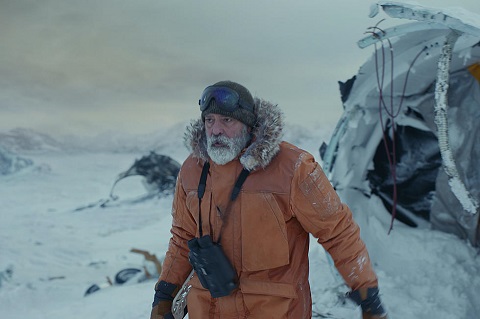
It's happened, a global disaster that has wiped out the entire human race. Well, almost: one man has been left behind, Augustine (George Clooney), who is suffering terminal cancer and must have regular blood transfusions to stay alive, for a while at least. The trouble is, he has no one to share his Arctic base with, as everyone else elected to leave for their respective homes to see out the catastrophe with their loved ones, so his loneliness is beginning to bite as much as the cold and the tumours. However, he has a mission still to fulfil... out there in space, there is a fully crewed spacecraft returning to Earth with no idea of what has happened.
The Midnight Sky, according to its producer-star-director Clooney, was inspired by two recent films, one of which he had been in, first, The Revenant for the sections where his character battled the elements to get to a radio base to send a message to the spacecraft, and second, Gravity, for the actual sequences featuring the craft which featured Felicity Jones and David Oyelowo as husband and wife who for reasons best known to themselves had gotten her character pregnant during their voyage. This might have been considered dangerous in a more sensible movie, but there was a thrown together quality to its plot that suggested nobody had quite thought it through.
For a start, almost EVERYONE IN THE WORLD DIES! And none of the people we see are all that bothered. You could just about believe that Augustine's apathy would have been born of his own illness putting a selfish perspective on his views, but nobody on the spaceship panics, wonders what the hell has happened, breaks down in tears, they're all numbly professional about billions of lives being snuffed out. Again, you could reason that the crew were keen to keep their heads and accept all that life was throwing at them, possibly because that was in their training, yet the casual nature of effecting a genocide of the human race for what turned out to be a domestic one to one insulted.
It was the sort of hyperbole that belonged in something more adolescent, but it wasn't even space aliens (as far as we knew) who destroyed the surface of the planet, indeed the film did not so much as give us poor bastards who died an explanation of why. Were we really more expendable on an unimaginable scale compared to movie stars who apparently mattered so much further? Okay, the future of the human race depended on these astronauts, but there were so few of them that they would never be able to adequately populate this new world they have been exploring, assuming they made it back in their damaged ship, not without serious inbreeding anyway, and a plot development part of the way through saw to it that they were on a hiding to nothing if they tried to procreate to survive.
Meanwhile, back on what's left of Earth, Augustine found another survivor, a little girl who doesn't speak he surmises is called Iris (Caoilinn Springall). If you don't work out who she is really within about ten nanoseconds of her initial appearance then you're just not trying, yet the storyline pursued this science fiction cliché as if it were the freshest idea in the world. Clooney certainly made decent use of his budget, with some pretty pictures conjuring an atmosphere of emptiness, but that quickly became futility the more this went on, especially when its notions of peril simply rendered any hope for the future moot. This seemingly unintentional nihilism was its real Achilles' Heel, since you could see no point in any of this continuing from an early stage, and despite the occasional action sequence the torpor that afflicted the rest of it was difficult to shift, never mind break through to engage with. The Midnight Sky was both too big in its concept and too petty in its focus. But it did look expensive. Music by Alexandre Desplat.
One of the biggest stars in Hollywood, Clooney became a household name with the TV hospital drama ER before going on to star in films like Three Kings, O Brother, Where Art Thou?, Ocean's Eleven and Gravity. Set up production company Section Eight Ltd with Steven Soderbergh, and made a successful directorial debut with the skewed Chuck Barris biopic Confessions of a Dangerous Mind. Clooney's second film at the helm was 2005's acclaimed drama Good Night, and Good Luck which he followed with sporting drama Leathernecks, political drama The Ides of March and wartime caper The Monuments Men. The Midnight Sky was a disappointing science fiction drama for Netflix.