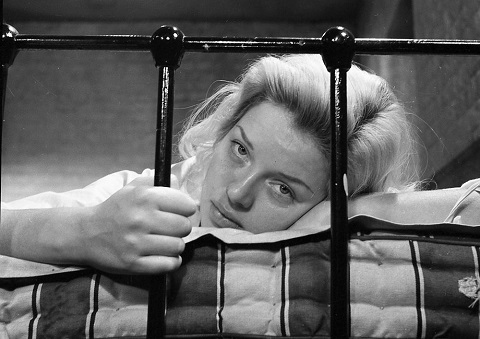
Mary Hilton (Diana Dors) is a criminal, in fact she has committed the worst act anyone can perform: cold-blooded murder. In broad daylight, she fetched a pistol from her apartment and walked over to her victim's home - she was getting out of her car when Mary arrived, and was gunned down as she emptied the chambers into her, every single one. Naturally, she has been convicted and unrepentant she sits in her cell, awaiting the call to either take a life sentence or the death penalty, brooding away her days as she contemplates the man she loved - Jim Lancaster (Michael Craig) - and not her victim. Does she deserve to live or die, is the matter in hand.
The question of whether Britain should still have the death penalty was very much in the headlines in the nineteen-fifties, and thanks to high profile cases like Timothy Evans, Derek Bentley and Ruth Ellis, the public mood was turning against the idea, so the politicians followed suit, indeed by the time this film was released on the subject capital punishment was close to being abolished. Ellis was important to Yield to the Night, for her execution in 1955 had been regarded as deeply unfair since her crime was one of passion, and the movie became linked in the audience's mind as being about her, though the makers pointed out the Joan Henry book it was based on had been published earlier.
Nevertheless, it was a serious picture about a serious subject, and in mid-fifties Britain it helped reassure that the right decision had been banned in outlawing the practice of state sanctioned killings. Watching it, you can kind of see why, yet it was an interesting piece for all sorts of reasons, not least because it attempts to convince you Mary should not die even though she has fully accepted her guilt and is not about to so much as say sorry, never mind make anyone feel better by allowing her hard shell to crack and, say, welcome her mother and brother on visiting days: she makes it clear she has no interest in seeing them, and wishes to live with her actions from now on.
However long that life may take. Director J. Lee Thompson, who would go on to be a thriller and action specialist after a spell helming social pictures like this and its predecessor The Weak and the Wicked (also based on a story by Joan Henry, who he would marry for a while), was confident this was his best film, and he was not alone in that assessment for Diana Dors thought it was possibly her best as well. She had been known as the British Marilyn Monroe, though both stars had become famous around the same time, but was keen to prove herself more than capable of pin-up roles and eagerly took the lead here, earning some very flattering notices. It may have been one of the first instances of a renowned glamourpuss taking a deliberately dressed down part to demonstrate how effective their acting could be, a pattern that repeats to this day.
One aspect that made this compelling was that it made a virtue of an ending the viewer could see coming a mile away, and the atmosphere of encroaching doom was all the more tangible for the prison guards' compassion as they busy themselves with trivial games of chess or patience while they keep a watch over Mary. Yvonne Mitchell, always an empathetic performer, was the main support for her as a guard, not exactly a shoulder to cry on but a mixture of the practical and the caring that helps to bring the audience's emotions into a sharper relief. In flashbacks which explain why Mary did what she did, Michael Craig played the lover she was obsessed with while he was obsessed in turn with the victim, portrayed obliquely as a man-eating ice queen, and he was convincing as a man who is outwardly confident but inwardly cracking up. But it was Dors' film, and with her roots showing and dressed in plain prison uniform, she took the opportunity to show she was more than a pretty face with great skill, which she then squandered in favour of nothing roles in a try at Hollywood. Not a fun film by any means, but a rare film noir, British or American, to detail the femme fatale's side of the equation. Music by Ray Martin.
[Yield to the Night is released on Blu-ray by Studiocanal with these excellent features:
New: Interview with Michael Craig
New: Interview with Melanie Williams, film historian and author
Film Fanfare - no 19 - Diana Dors interview (1956)
Film Fanfare - no 12 - Yield to the Night Premiere (1957)
Behind the Scenes stills gallery.]