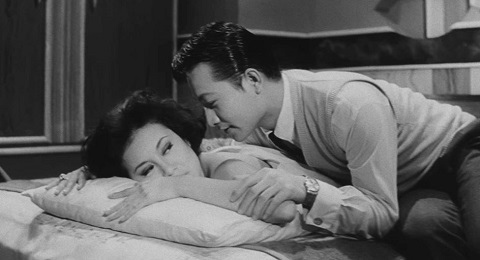
Tai Giok (Chang Ching-Ching) lounges on her bed as her lover gets ready to leave, comfortable in the knowledge that although he plans to marry the boss's daughter, that is a purely career-motivated decision and it is his girlfriend he actually loves. But her association with an ex-boyfriend, Tenn Kong-Hui (Wu Tung-Ju), may prove to be more dangerous than she expected, for when he shows up, he makes it apparent in no uncertain terms that he is going to blackmail the people in her life who he has been spying on, and he will use this both as leverage to make a substantial, if illegal, profit, and get back into bed - literally - with his ex-romantic partner. They both could be making a major mistake...
Six Suspects was almost a lost film, for its director Lin Tuan-Chiu got fed up with it and did not believe it was worth releasing, but it was put out by the Taiwan Film Institute, along with others of his canon, in the hope it would attract interest in both his oeuvre and that of others of his ilk from his Taiwanese homeland. Not that he would be around to enjoy this attention, for he died in 1998, and indeed had given up filmmaking after completing this effort, apparently walking away because he didn't think he was in the right line of work. Now we can see this item in particular, we can judge if we think he did the correct thing, or whether we lost a promising talent just at the stage he should have been nurtured.
Certainly, Six Suspects is far from a disaster, as far as artistic concerns went. What it appears to be trying to be is an Agatha Christie-style whodunnit, with a collection of suspects and a big solution for the final act that may or may not be too convoluted to believe, depending on your tolerance for this sort of mystery that relied so heavily on the audience being compelled to stick around for almost two hours to get their revelation. Oddly, there was an extensive information card in the opening credits that delivered Lin's full faith in the local police, either because he wanted to reassure the viewers or because he wanted to stave off the possibility of being "leaned on" by the constabulary who would have seen this and not been wholly satisfied the average Taiwanese lawman had been painted in altogether flattering light.
Corruption at all levels came across as the director's preoccupation here, so the scheming blackmailers like Tenn are on the lowest strata, squeezing the ransoms out of their victims, yet the victims are not blameless either as they are getting up to white collar crime and cheating one another in an unlovely race to the top, as meanwhile the cops do their best to sustain this status quo by passing over the chance to dismantle the power structure in favour of going after the petty criminals, because it makes them look better to the public. It had to be said, this was all very noble a goal to highlight this sort of business, but Lin did allow the pace to slacken in the lengthy middle section where you're unsure of who has done what to whom and he's not about to blow his big reveal this early in the running time. It did pick up by the finale, for a reflective exposure of what really had occurred, and that was perfectly fair, but a tightening up of the script could have made for a gem, rather than a curio. Music by Tseng Chung-Ying.