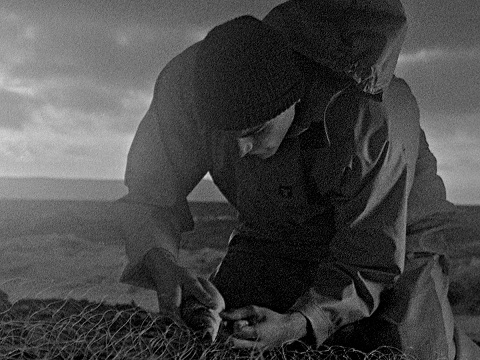
Martin Ward (Edward Rowe) is a fisherman in Cornwall, but times are growing increasingly tough now that the boat he owned with his brother Steven (Giles King) has been taken away from him: Steven now uses it for the many tourists to the area, to take out on the sea for pleasure cruises to scrape by his own living. This has resulted in some resentment between the siblings, and worse than that, Martin has been forced from the family home into a smaller abode while Steven uses his old house as a bed and breakfast for those tourists. It appears that as time goes by and Steven fails to adjust, there will be a reckoning for both of them...
Writer and director Mark Jenkin was working with minimal means himself when he shot Bait on a 16mm Bolex camera - one he had to wind up to get it to work - which did not have any sound on it. The dialogue, music and effects were placed on the soundtrack later, in post-production, after he had developed the film alone in his darkroom, so you either react to that information in one of two ways: you think, how wonderful, an actual artisan movie, almost literally handcrafted and assembled like the cinematic equivalent of a folk song, or you think, bloody hell, is there nothing else that the artisan community cannot conjure up, they're even making films now?
Despite the reservations of many, Jenkin was completely sincere in his methods, and if that came across as somewhat "pretentious, moi?" in the style of keeping it real with the fishing community in his native Cornwall, then so be it. The trouble with this sort of thing was, of course, that he was preaching to the choir, and anyone who harboured (so to speak) a deep-seated suspicion of the motives of the artier end of British filmmaking, or any nation's filmmaking for that matter, was not going to have their Road to Damascus moment while watching this. In fact, that kind of reaction was likely to be the reason most left efforts like this to the critics and aesthetes.
Not that aesthetes don't deserve entertainment and stimulation as much as anyone seeking post-pub diversions over their pizza, the film world is a broad church, it's more that every time something as involved and obscure as Bait began to gather traction, it felt like cultural battle lines were being drawn, and that could make you feel very weary indeed. As this stood, it was neither a masterpiece nor a disaster best relegated to the snobs, it looked like what it was, more or less a one-man show (the acting aside) in the vein of many of the more resourceful British directors who for whatever motive were left to operate on a budget that would cover the catering on many a blockbuster. For some, that was a badge of honour, for others, it was always going to be a turn-off and a barrier for them.
There was a social and political aspect here that was knitted into the plot, the complaints about the tourist industry being the only thing propping up picturesque areas of Britain now the industries they had previously existed on for centuries had been wound down or neglected, all of which was perfectly valid and worth discussing. Whether it was worth discussing in the context of a somewhat forced tragedy delivered by performances that would look a lot more amateurish had they not had the boost of Jenkin's obscuring techniques was another question, and you worry the people this would most apply to and most get through to would never consider picking it up because it was trapped in an art movie ghetto. Actually, if Jenkin had filmed it more conventionally, he would have reached more of the audience he should have been appealing towards, but then if he had, he would probably not have enjoyed the critical acclaim. Maybe it's not fair to land these concerns on a small project such as Bait, but this was the landscape it arrived in.