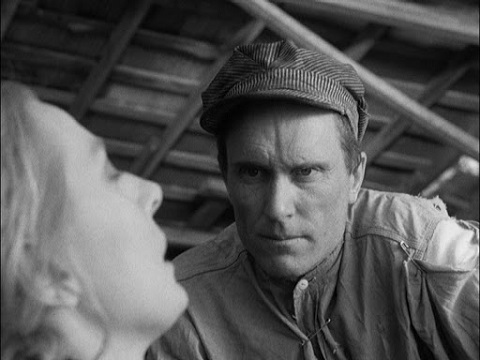
When Jackson Fentry (Robert Duvall) was called up for jury duty after a young ne'erdowell was shot dead and his attacker put on trial, nobody expected him to be the sole member to ruin the case since everyone else regarded the deceased as having got what was coming to him. Not Fentry, though, and to understand why you had to go back twenty years to when he had been hired to look after a wealthy farmer's boiler house, which he did all on his own and apparently was unbothered by the solitude. However, one day as he was about to return to his father's farm for the Christmas holiday, he happened to be preparing to leave when he found an exhausted woman, Sarah Eubanks (Olga Bellin), lying near the shed where he had been living. What was she doing here?
Tomorrow was a very low budget, black and white film that had an impressive pedigree. Some low budgeters of that era could end up with a Night of the Living Dead, but not this bunch, for they wanted to adapt a William Faulkner short story as lyrically as possible, making a virtue of its winter setting to craft the closest thing they could get to poetry on the screen and for many viewers, they succeeded admirably. It was more or less ignored on its initial release, despite star Duvall mentioning it as one of his favourite roles, but when he reteamed with scriptwriter Horton Foote on the Oscar-winner Tender Mercies, which was not dissimilar to this, the earlier picture gained more recognition since you could discern the virtues of the awards-worthy effort started here.
Certainly Billy Bob Thornton was impressed with Tomorrow, for he lifted his performance wholesale for Thornton's much-lauded Sling Blade to a distracting degree, and the same sort of folks who admired that would be the sort who admired the 1972 Faulkner adaptation. The problem with both interpretations was that they were incredibly affected, to the extent that you could see the gears working in both of them to create some plain and simple fellow who had hidden depths of compassion that nobody around would ever acknowledge. That was the reason the fans found this affecting, the portrayal of a man who has enormous reserves of love that for a short while come in useful for him, until harsh life intervenes and reasserts itself and he must go back to his thwarted existence as a poverty-stricken, well, hick was what he was.
The point that even in the bleakest of surroundings, love can find a way was all very well, but you could tell from even a five minute stretch of Tomorrow that it would never last, and the film had some severe lessons to teach you in its goal of moving the audience to tears. You would be unlikely to be in tears if the performances did not succeed for you, and that was the main problem: many of the far smaller roles were convincingly rustic, but Duvall and especially Bellin were too studied to be anything but self-conscious, even condescending, and further than that in Bellin there was a sense of the actress patting herself on the back for her stylings. What might have been effective on the page, as so often with the great writers whose technique was a large part of why they were so praised, was exposed rather blatantly when someone tried to film their endeavours, and considering it was a fairly brief read, it came across as far too drawn out as a movie to be comfortable to watch. A noble attempt, sure, but definitely not for everyone. Music by Irwin Stahl.