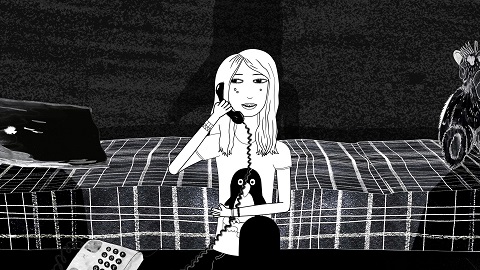
Paola (voiced by Martina Toro as a child and María Cecilia Sánchez as a teenager) was conceived in 1976, but nobody believed her mother when she claimed she was pregnant, since she had had her "tubes tied" as they said. The doctors she saw told her she must have some kind of tropical virus that had caused her to have cravings, dizziness, and vomiting, as well as gaining weight, but her mother certainly believed she was right and baby number three was on the way. Therefore when she did give birth, it was a surprise to everyone except her, and Paola was in the world, daughter of a priest who had given up his duties so that he could get married and start a family with his wife...
The film most commonly mentioned in connection to Virus Tropical was Persepolis, the Middle Eastern autobiographical tale of a few years before that had made such a huge impression on many who saw it around the world. They were both told from the perspective of a young girl who was growing up, looked back on by her older self and related through the medium of comic books, and both were portrayed in hand drawn black and white with simple, stylised characters and details that appeared almost faux naïve. This one was based on the work of Ecuadorian-Colombian artist Power Paola, also known as Paola Gaviria, and one thing her early life had in its favour was no war.
Not that she singles out, anyway, obviously there was a war on drugs (or drugs barons) happening in Central America at this time we see unfold, and drugs do make an appearance when Paola's older sisters start to dabble, but this was keen not to define the nations it depicted through the kind of issues that a Hollywood movie would have focused on had they been making a story set in Central America. That was refreshing, and though it was not packed with rollicking humour, there was an amused tone to the proceedings, as if Paola was reminiscing with a half-acceptance, half-disbelief at the sort of activity she and her sisters got up to when she was in her most formative years.
We took in more or less the whole of the protagonist's childhood, and while it was impossible to tell how much embellishing was being added to the yarns, which were highly anecdotal throughout, they did have the ring of truth. Director Santiago Caicedo was obviously keen to stick as closely to the text as he could, offering a weirdly homemade delivery to Gaviria's pages, rather than a Pixar-esque slick as you like, glossy and intricately detailed sheen., most probably because he just did not have the money at his budget's disposal for that kind of finish, yet also because with the almost amateurish presentation, it did come across as more authentic. Authenticity was a must here, we had to believe in what Paola was telling us, so there were no magic realist touches or diversions, for example.
So, what was she telling us? Much like Roma the following year, this was a Central American movie with a downer on men, though that was thanks largely to the protagonist spending her time with females and getting their perspective almost exclusively, to the point that men were "alien" to her by the stage she had enrolled in a mixed-gender school after a move of country. Paola does not have it easy, and that can be placed at the blame of the males like her father who lets the family down, first by leaving them because of health problems, and then financially when he makes an idiotic decision to invest their savings with a scam. Then again, the females make problems for themselves as easily as the men do, even if it's due to picking the wrong partner (not that we see an example of a right partner). This did convey an honesty that, if nothing world-shattering occurred in what we watched, contained enough personal upheaval, as any life does, that the lack of a real climax merely meant a set-up for another instalment was necessary. Music by Adriana García Galán.