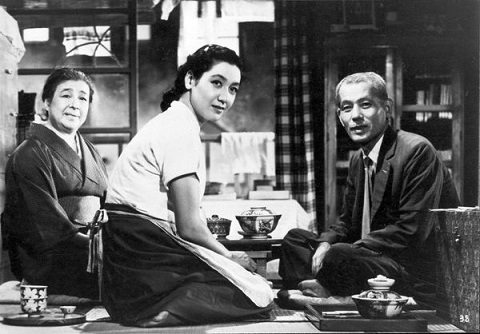
Mr and Mrs Hirayama (Chishû Ryû and Chieko Higashiyama) are an elderly couple who live some distance away from their adult children, who all stay in the Japanese capital, Tokyo. For this reason, they do not get to see them as often as they would prefer, as the journey to get there is a long one even by train, and the sons and daughters are reluctant to make the trip the other way, being too busy. They have lost one son in the war, leaving his widow Noriko (Setsuko Hara) to live alone, and she would love to see them, but the other two who live in Tokyo - one daughter, a schoolteacher, remains at home - simply do not have the time to spend with them. But a holiday's a holiday...
Tokyo Story is generally regarded as Japanese director Yasujirô Ozu's masterpiece, though not an experience that often crosses over into the mainstream of respected classics in the way that his contemporary Akira Kurosawa's efforts did, Kurosawa usually cited in the West as the greatest of all filmmakers from The Land of the Rising Sun. It can be somewhat daunting to sit down in front of a supposedly perfect movie and feel the pressure to be impressed, especially from someone with such an exacting command of technique as Ozu, with his camera static and fixed in one place just above the floor level, extensive studio shooting, and shots of his cast in near-closeup staring into the camera.
As if they are addressing the audience rather than the characters we are intended to be sympathising with, which were the grandparents in this instance. Ozu had a lot of affection for the older generation of Japan in his era, the ones who had seen their country bombed to kingdom come, lost their sons and were forced to struggle as they got older with a modern world that was dispassionately leaving them behind, as evinced by the behaviour of the couple's children. The director lived with his mother for his whole life, which was not as long a life as he deserved, and was not shy about how much connection he felt to them and their generation, and his scepticism about the young.
Therefore what you had with Tokyo Story could in some views have been designed as a massive guilt trip for those who are being accused of neglecting their parents as they get older: the grandkids we see are if anything even worse, either petulant brats or utterly disinterested in their grandparents, which was the nightmare future Ozu envisioned for Japan - what he would have made of his nation's student uprising in the next decade, that generation of those grandkids who revolted against their elders, does not bear thinking about, yet you can guess whose side he would have been on. This means the film, and indeed most of his films that made any impression, could give the appearance of the work of a grump who saw nothing good in progress and placed tradition on a pedestal.
While all that may be true, my goodness if Tokyo Story doesn't manage to fulfil its goal as a tearjerker nevertheless. It's just not as clear cut as that generation gap assessment might indicate, for Ozu understands life is more complicated when we have so many things in need of attention that consequently has us having to put some of them above others, and we may not always make the right decisions. For a start, our parents will not be around forever, and as they grow closer to their passing, our time with them should be more precious, yet as the adult children here do, we can get into a groove where we just accept and keep putting off the opportunities to be around them, and that's even with those who have a good relationship with their mother and father. Oddly, it is Noriko who pulls at the heartstrings the most, she treats them far better than their blood relatives because she is well aware what it is like to lose loved ones. Her conclusion that "Life is disappointment" is terrible to admit, but in a tragic way, you wonder if she is correct. A daunting film for one so gentle, but it has a hard edge you don't anticipate. Music by Takanobu Saitô.
[Tokyo Story is released by The BFI on Blu-ray with the following features:
Remastered in 4K with an uncompressed monaural soundtrack
An introduction to Tokyo Story (2020, 26 mins): Asian-cinema expert Tony Rayns provides an introduction to Ozu's most acclaimed film
Brothers and Sisters of the Toda Family (1941, 105 mins): following the death of her husband, Mrs Toda realises she has been left with sizeable debts and an extended family reluctant to support her
Talking with Ozu (1993, 40 mins): a tribute to the legendary director featuring filmmakers Lindsay Anderson, Claire Denis, Hou Hsiao-hsien, Aki Kaurismäki, Stanley Kwan, Paul Schradar and Wim Wenders
Furnival and Son (1948, 19 mins): recounts the difficult choice a recently demobbed serviceman has to make between an unexpected job offer elsewhere, and resuming his pre-war position as his father's cutlery firm, Furnival and Son
image gallery
***FIRST PRESSING ONLY*** Fully illustrated booklet including an essay by Professor Joan Mellen, archival writing by John Gillett and Lindsay Anderson and a biography of Yasujiro Ozu by Tony Rayns.]




 9 (from 2 votes)