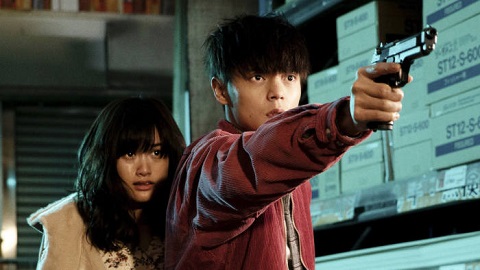
Leo (Masataka Kubota) is a boxer who puts his life into his training for each match, and it pays off as he is one of the most promising pugilists around, but his trainer wishes he could show at least a little emotion once in a while, because even when he wins he just stands there impassively instead of, say, jumping up and down and cheering. There's obviously something missing in Leo's life, and it could be a lack of love: he has no partner, and shows no interest in securing one. Meanwhile, across the city the meth-addled prostitute Monica (Sakurako Konishi) craves her next fix, hallucinating her abusive father is trying to get her, the one who sold her into this sexual drudgery to pay off a debt...
These two were obviously destined to meet, but the way they went about it, and what happened when they did, was what took up most of this film's attention. It was one of director Takashi Miike's efforts, though scripted by Masa Nakamura not himself, and for some it was more evidence he was mellowing in his old age: an actual romance from the Japanese king of transgression? Well, there were caveats, you wouldn't get many Hollywood love stories beginning with a chopped off head rolling into the street, but it was accurate to observe there was something weirdly sweet about the central relationship that was not common in Miike's earlier work, the ones that made his name.
Was he getting sentimental, or (more likely) was he merely reacting to the demands of the Japanese market as it moved into the twenty-twenties, where the more extreme movies were growing ever more niche and separate from the mainstream? He had always been a commercial filmmaker inasmuch as he wanted to make a profit from his movies, and that had often meant going way over the top and way out there in his imagery, but you could favourably compare his endeavours here to Quentin Tarantino and Tony Scott's True Romance, which appeared to be the template they were following for what was essentially a lovers on the run from violent criminals yarn, a familiar one too.
Nevertheless, it was not as if Miike was consciously copying great swathes of that nineties cult favourite to craft an answer to it from across the Pacific, as First Love, or Hatsukoi as it was called in its native land, remained an identifiably Japanese thriller, and not only because it starred a bunch of local actors. Some found the way the story ploughed forward with little regard to allowing any stragglers in the audience time to catch up confusing, but it was more understandable than they gave it credit for as if you paid attention the pieces fell into place quite pleasingly after a while. It was even reminiscent of Martin Scorsese's After Hours in the way it took place largely over the course of one increasingly bizarre night, though it did overlap in the day before darkness fell and the eventual dawning of the following morning.
Our hero Leo has hit a wall in his career after a severe knockout mid-match which has sent him to the doctor for a check-up, wisely as it turns out since he is revealed to have a brain tumour, and worse, it is inoperable: he has not long to live. This makes his life more precious, or it should for the time he has left, but as he has no one to make it meaningful he is typically numb, that is until he meets Monica fleeing a corrupt cop who was going exploit the girl. Leo decks the cop, steals his badge and the new couple race off on foot to escape both the yakuza and the triads who are brewing a gang war between them, and would really like the meth the pair have accidentally acquired from them. Yes, the violence was there, but not as strong as before - though bits and pieces still get chopped off or smashed, British-Japanese actress Becky proving a memorable turn as both a survivor and instigator of same: she gets singed, too. Really, for all its setpiece action, this was a more generous Miike, and appealed to see how he could adapt. Music by Kôji Endô.
Japan’s most controversial director, notorious for his dauntingly prolific output and willingness to push the boundaries of taste. Miike started working as an assistant director in the late 80s, before moving into making straight-to-video thrillers in 1991. He made his feature debut in 1995 with the violent cop thriller Shinjuku Triad Society, and since then has averaged around seven films year.