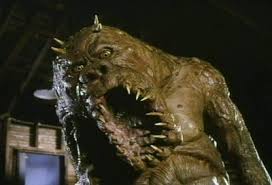
A portentous Rod Serling-style narrator recounts a string of bizarre murders occurring throughout Chestnut Hills, California. An old blind man, his dog, a stroppy little girl and a married couple are all slain by an unseen menace that emerges inexplicably from their closets. Only to vanish just as mysteriously from whence it came. Clark Kent look-alike rookie news reporter Richard Clark (Donald Grant) is tricked by a smarmy rival into covering the attacks which many believe to be a hoax. Local sheriff Sam Ketchum (Claude Akins) suspects a serial killer is at large but, along with the rest of the town, is quickly confronted by a huge, hideous slobbering monster (played by Kevin Peter Hall, the most reliable man-in-a-monster suit of the Eighties). In the midst of the monster's now-nationwide rampage, Richard befriends child genius 'Professor' Bennett (a young Paul Walker) and his health-conscious single mother, brilliant scientist Diane (Denise DuBarry). Intrigued by the unfathomable, seemingly unstoppable creature, Diane, her mentor Dr. Pennyworth (Henry Gibson) and uncle, Catholic priest Father Finnegan (Howard Duff) try to find a way to communicate with it before humanity is doomed.
One of the very, very few Troma productions actually worth anything, Monster in the Closet is a horror-comedy gem from the Eighties. A delightful pastiche of Fifties monster movies in the style of Mel Brooks. Today the film is largely remembered for featuring early roles for Paul Walker, future star of the Fast and Furious franchise, and Stacey Ferguson a.k.a. Fergie, singer with The Black-Eyed Peas. The future Fergalicious one plays the little girl devoured in the opening montage of monster attacks. Mercifully off-screen because unlike Troma's Rabid Grannies (1988), Monster in the Closet grasps the difference between a good bad-taste gag and a bad bad-taste gag. Alongside the young stars-to-be are a fun cameos from affable genre veterans Claude Akins, John Carradine (on screen for just a fleeting moment but really committing to his comedy blind guy bit), Stella Stevens (in a nude shower scene as part of a witty Psycho (1960) send-up with a solid punchline), Paul Dooley and the ever-watchable Henry Gibson as an Einstein look-alike scientist. You also have Donald Moffat relishing an all too rare humourous turn as ranting General Turnbull.
In his only credit as writer-director Bob Dahlin, who after making this film resumed his long career as a first assistant director, crafts a witty script with likable characters, clever dialogue and quirky, genuinely laughs. While Dahlin does bludgeon the occasional gag to death (i.e. Pennyworth repeating the same anecdote about dissecting a frog; title cards that flash the precise date, time and location of each scene) the film maintains a consistent level of ingenuity. With gags both broadly satirical (e.g. Father Finnegan's hilarious graveside sermon; Richard nonchalantly munching candy bars while he and the scientists stalk the monster; Pennyworth using a xylophone to communicate with the beast in a jab at Steven Spielberg's touchy-feely brand of science fiction) and surprisingly subtle (Diane repeatedly breaking her arguments down to bullet points; the newsroom styled as a parody of All the President's Men (1976) including mention of a reporter named Hoffman).
The aspect of the film's humour that proves especially potent is its send-up and subversion of Fifties monster movie tropes. While the Eighties were indeed an era when baby boomers crafted many a loving homage to the science fiction of their youth, Monster in the Closet both captures the tone of the genre, working in ingenious allusions to Creature from the Black Lagoon (1954), Them! (1954), The War of the Worlds (1953), Robot Monster (1953), King Kong (technically 1933, but re-released in the Fifties) and The Twilight Zone, and cleverly subverts its clichés. Here it is the leading lady portraying the scientist who comes up with an ingenious last-minute solution to the monster menace while the male lead is the one who on removing his glasses dazzles everyone with their unexpected attractiveness. A joke that pays off with a hilarious twist in the third act capped by a perfect quote from King Kong. Dahlin's camera work is also fluid and inventive and the film maintains a brisk pace throughout, edited by Raja Gosnell future director of Scooby-Doo (2002) and The Smurfs (2011). Well, nobody's perfect. The monster is well designed and lifelike, sporting an Alien-style extendable second mouth and memorably bizarre grunting and snarling noises. In fact the film even pulls off one genuine shock scene all the more effective for puncturing a sweet romantic moment. On top of that the performances are all great, particularly lead actors Grant and DuBerry. Even the blatant product placement for Nestlé Crunch candy bars is not too egregious, since they are delicious anyway.