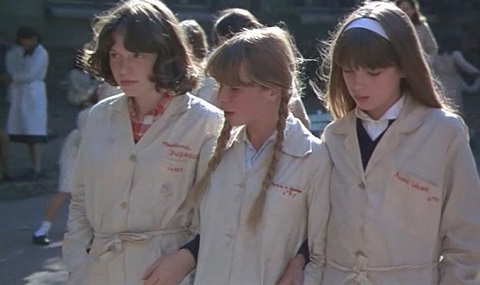
The Weber sisters, thirteen-year-old Anne (Eléonore Klarwein) and fifteen-year-old Frédérique (Odile Michel), spend the summer of 1963 at the beach with their father (Michel Puterflam), who is divorced from their mother (Anouk Ferjac). She is who they live with in Paris, but they find their father less than compelling, with the elder sibling more interested on cultivating a holiday romance with a local boy, though Anne likes him too but would never be able to admit it to him. Soon, the vacation is over, and it is time to climb back on the train home, waving goodbye to Mr Weber as he bats away their inquiry about when he will send his next cheque to his ex-wife. Then they have to return to school, happy to see their friends again, not so happy to see the teachers...
Diane Kurys, like a fair few female French directors, chose to take her cue from The 400 Blows and make a film about adolescence, in this case constructed from her memories of growing up as a thirteen-year old in the Paris of the early-to-mid nineteen-sixties. It certainly struck a chord with French audiences of the late seventies, not merely the moviegoers of her generation but it appealed across the board, and provided a solid groundwork for her blossoming career as she left acting behind to craft her own stories. She recruited a young cast to portray the schoolgirls, and a selection of frequently eccentric-looking performers for the adults, Ferjac aside, though she had her moments.
Thanks to the raiding of her memories for her script, Kurys offered a method of telling her story that was more serving up a bunch of little stories, as if we were dropping in on Anne's life seen from a perspective of some years in the future, where moments of great importance were interspersed with remembrances of what was almost trivia: what songs were playing on the radio (Cliff Richard's Living Doll kicks things off), what they liked to drink in the cafes (the titular peppermint soda, usually), the conversations with her pals about boys who, since this was an all-girls school they were attending, were a source of great fascination yet also great frustration. The major events in the nation, the world, were treated in much the same approach.
Or even downplayed: Anne hears about the assassination of President Kennedy and has no comprehension of why her French teacher the next day is in tears and writing a quote about death coming to us all on the blackboard, it's just something that happened that will not affect her in any great detail. However, when we follow Frédérique in the second half of the film, we notice her political consciousness is being raised and she feels, as she hails from a Jewish family, that she should be taking a stand against fascism, a portent of the student riots to come in this decade. Indeed, when Anne's class is ignoring the teacher during a lesson touching on politics, it seems Kurys is sad that they will soon lose their innocence as they must engage with that world, since it makes everything so serious.
Yet there was a sense of the progress through the year between summers being akin to a stone skipping across the surface of the water, bouncing into various incidents before finally sinking as adulthood pulls them under. It's certainly not plain sailing being an adolescent girl, Kurys tells us, from the menstrual cramps to the dirty old men who hover around, and that's without going into the issues with romance they are not mature enough to cope with, flitting from emotion to emotion as they affect them deeply but also somehow without really harming them. The fact of the sisters' divorced parents must surely prepare them for potential disappointment, yet they don't appear to think that way, not having personal experience in that arena other than second hand from their mother's trials and tribulations. If Kurys leaned on caricature in places, it was because this is the way the adult world came across to these teens in a work that was superficially inconsequential, but contained a cumulative interest: by the end, you may be surprisingly invested. Kurys' next film was a semi-sequel to this, Cocktail Molotov. Music by Yves Simon.
[The BFI's restored, pristine Blu-ray has an interview with Kurys and a look through her scrapbook as extras on the disc, plus a booklet.]