Harry Fabian is a small fry American con man working in London, where he earns a precarious living supported by girlfriend Mary. Desperate for the big time he uses a chance meeting with aging wrestling star Gregorius to set himself up as a fight promoter. He tricks nightclub manager Phil Nosseross and his wife Helen into providing the stake money. Everything goes wrong when Gregorius is injured during a bout and dies, leaving Fabian at the mercy of his son Kristo, a powerful wrestling magnate. Fabian goes on the run, a fatal price on his head…
Night and the City was made for the wrong reasons. UK law at the time restricted profits earned in Britain by Hollywood movies from going back to America. The money was duly used to finance a series of bland US productions filmed in Europe with American stars. Night and the City’s director Jules Dassin no doubt saw the London location as a welcome chance to evade the McCarthyite House Committee on Un-American Activities – this was his final Hollywood film before being blacklisted. Sensing that time is running out, he fills the screen with anger and desperation – few studio financed films dare show the sacred American profit motive as so bleak and self destructive.
Dassin’s London is a million miles from the cosy city depicted in contemporary British films. Interior sets and location filming create a nightmare closer to American noir than Ealing comedy. This is a town of cluttered apartments, shabby clubs and dark alleyways. It is a London barely emerged from the Blitz: Fabian meets Helen in a bar that is little more than a bomb crater – naked candles light suspicious, furtive faces. Nine years before Jean-Luc Godard picked up a camera and roamed through Paris, Dassin plunges into the real London. When Fabian encounters Nosseross in Trafalgar Square there isn’t the usual establishing shot of Nelson’s column; like the characters we never look up from the teeming pavements. Later Kristo’s henchman puts the word out on Fabian: we follow him as he drives through the garish lights of the West End, characters leaning into the car to receive the message; Dassin then shows the death sentence passing like a virus through the city’s arcades, dog tracks and pubs. As Harry Fabian’s world collapses, London becomes increasingly surreal – a rubble strewn wasteland could be the surface of the moon, flames blaze from a factory as if from hell itself. Fabian finally meets his destiny by the river, Chelsea Bridge looming out of the morning mist like a funeral barge.
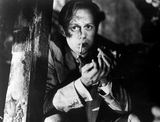
And at the centre of this dark, delirious universe is one of noir’s great anti-heroes. Harry Fabian was Richard Widmark’s finest role. He plays him as a man literally possessed by his dream of a “life of easy and plenty”. This neurotic need for success (“I just wanna be somebody”) means he’s nearly always in motion. We first see him fleeing through a deserted London after his latest get rich scheme has gone belly up. His bone thin body is constantly animated as he hustles, cheats and lies; the grin becoming forced, the face sweatier, the laughter more desperate whenever events spin out of control. He ends the film where he began, running for his life in the night. Only now the streets aren’t empty – the city’s low lives have turned against him and there is nowhere to hide. Why do we sympathize with a pathetic con man who’s catastrophic scheme leaves three people dead and other lives blighted? Dassin and Widmark elevate the story to an almost Greeklike tragedy; the inferno into which Fabian descends seems out of all proportion to the squalid crimes he’s committed. The flaw which destroys him is an inability to comprehend love. Ultimately it’s Nosseross’ love for Helen that dooms Fabian’s enterprise; Kristo’s need to avenge the father he adores seals his fate. Fabian’s relationship with girlfriend Mary is telling. He tries to steal from her purse and ignores her pleas to reform. His final act is an attempt to convince his hunters that she has betrayed him – that way she can at least claim the blood money (“For the first time in my life it’s a foolproof idea”). This seems a grim perversion of the doomed man’s last romantic gesture. Strangely, as with other tragic heroes, there is a sense of failed potential. Without his obsession with a wealth and power he can never attain Fabian might actually have achieved something. As Mary says: “You could have been anything, anything. You had brains, ambition. You worked harder than any ten men. But at the wrong things, always the wrong things.” Widmark’s last monologue as, exhausted, Fabian waits for the end, is a brilliant piece of screen acting. Like Marlon Brando’s later “contender” speech in On the Waterfront it transforms a defeated no-hoper into a representative for everyone whose dreams have foundered. We finally see ourselves in this despairing little con artist.
Fabian’s disastrous scheme engulfs others. Herbert Lom and Francis L. Sullivan were two of cinema’s most sinister heavies. Here their menace is tempered by humanity. Lom’s Kristo is painfully estranged from his father: Gregorius despises the commercial wrestling that Kristo promotes. It is deeply moving to watch Kristo comfort him as he dies. Sullivan’s obese nightclub owner Phil Nosseross is much more than the traditional fat man of noir thrillers. He is devoted to his wife and we see his soul shrivel as he realizes how much she loathes him. His massive body seems to shrink with the shameful knowledge that he will take her back no matter what she’s done; ultimately he can’t stand it anymore and kills himself. And Googie Withers is a revelation as the object of his affections: Helen Nosseross is ruthless and vulnerable, shrill and grasping yet also appealing. Of the supporting players only Gene Tierney as Mary fails to convince. Where the others squirm with a living seediness she is always the Hollywood star, pale and aloof.
Night and the City remains Dassin’s best work. It is a film that defies easy categorization. Classic London gangster movie? Noir masterpiece? Proto nouvelle vague? Or simply the greatest wrestling flick ever made? Watch it - especially if you only know the banal 1992 remake – and you’ll see what cinema was capable of in the hands of a director and actors of genius.