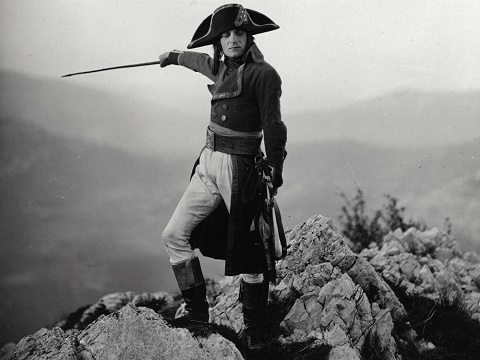
How does the life of one of the most influential men the world ever saw begin? Napoleon Bonaparte (Albert Dieudonné as an adult, Vladimir Roudenko as a child) was sent to a boarding school away from his Corsican home where he had been brought up so he could learn about the world and about military training, so as part of that during the Winter months the tutors would encourage the boys to carry out epic snowball fights where one side would be pitted against another, and Napoleon would be instrumental the victory for his team time and again thanks to his growing mind for strategy. But he was not popular there despite his expertise, thanks to his lowly beginnings, which gave him a real will to succeed...
Director Abel Gance concocted his epic Napoleon, sometimes known as Abel Gance's Napoleon just so you knew who was boss, over the course of a number of years, but it took many decades for it to be seen in some way appropriate to his wishes after its premiere in 1927, when it had been met with a mixed reception in some way thanks to his enormous ego that tended to rub people up the wrong way. It was as if Gance was so determined that his work should be a classic that he was willing to figuratively beat his audiences over the head with its overbearing masterpiece ambitions, so naturally not everyone was going to agree to be strongarmed into allowing the director the due he so obviously believed was his.
But perhaps the real hero was silent film expert and restorer Kevin Brownlow who spent a very long time painstakingly bringing the neglected elements back to their pristine condition; it could be that this enormous workload was enough to offer the film the standing that Gance believed should be given, and there was another aspect in that a rights issue over two specially composed music scores meant it was very difficult to see after the restoration's showing in 1981. This gave the production a glamour, like a long-lost artwork tantalisingly out of reach, that raised it to the level of an obsession, especially among silent movie buffs, though on watching it that fixation was nothing compared to the cascades of monomania that Gance had evidently displayed in every frame. And what frames! Every trick in the book to bring Napoleon to life was implemented.
This may be overwhelming to many viewers, and it was true that was likely the originator's intention, but there was no denying that these incredible reserves of energy Gance poured into his film delivered a memorable experience more often than not. However, if you were looking for a dry historical text about one of Europe's major leaders of the second millennium, this was not it, indeed you might not actually learn very much more than you already knew, assuming you had some vague idea from school or a TV documentary about what the French dictator got up to. Yet he was not a tyrant in Gance's eyes, actually you had the impression if he could have got away with playing Napoleon himself he would have leapt at it (he takes the supporting role of revolutionary Saint-Just instead), simply so he could be mentioned in the same breath as his historical hero, which may have been the point of this enterprise in the first place.
There's a character here who has a shrine to Napoleon which she prays to fervently, bringing to mind two images: one, Gance praying at his own shrine to him, and two, cineastes praying to Gance in the same manner as he would have magnanimously accepted as validation of his belief in his own genius. And yet, there are a fair number of points here where you think he might have been onto something, see the breakdown of the Revolution after its first, violent flush of success which is intercut with the title character thrown around in a tiny boat on a stormy sea which was genuinely thrilling, or the decadence of the dance where Napoleon becomes captivated with Josephine (Gina Manès), the great love of his life which is reflected in the wild abandon of the partygoers giving into their desires - and also offers us a disco Napoleon, judging by his spangly outfit which he sports in most scenes from then on.
Then again, there were points where Gance overreached himself, such as the long stretch where he invited us to share the protagonist's ardour for Josephine which you may not be entirely in agreement with, or the section where Napoleon proclaims his benevolent view of everyone doing everything he says (or else) to the ghosts of those executed in the Terror. But it would be the grand finale that brought the house down, a triptych where Gance used three screens projecting side by side simultaneously as Napoleon's Italian campaign brings him resounding victory, the final montage of an eagle (the childhood pet which represents his courage and freedom), thunder and lightning and his triumphant soldiers eventually shown in the red, white and blue of the Tricolore. So what happened next? The Jazz Singer, not this marathon, proved the must-see event of 1927, and sound was the big story in cinema, therefore lacking funds Gance went in the huff and never completed his prospective trilogy. That he would agree what he did complete was remarkable has been a self-aggrandising bone of contention in many quarters, but it was, for all its overconfidence and bombast, a work of a kind not seen before or since, and essential for anyone interested in the all-consuming madness that can overtake filmmakers on a mission.
[Throw away those bootlegs, the BFI have released a new 2K, five hours plus restoration on 3-disc Blu-ray with the following extras:
The Charm of Dynamite (Kevin Brownlow, 1968, 51 mins): BBC documentary on Glance's silent films, narrated by Lindsay Anderson
Composing Napoleon - An Interview with Carl Davis) (2016, 45 mins)
Feature-length commentary by Paul Cuff
Napoleon digital restoration featurette (2016, 5 mins)
Stills and Special Collections Gallery
Alternative single-screening ending
Individual triptych panel presentations
Illustrated 60-page book with writing by Paul Cuff, Kevin Brownlow and Hervé Dumont, an extensive interview with Carl Davis; and full film, music and restoration credits
If you have an interest in vintage cinema and a massive television screen, you owe it to yourself to see this.]