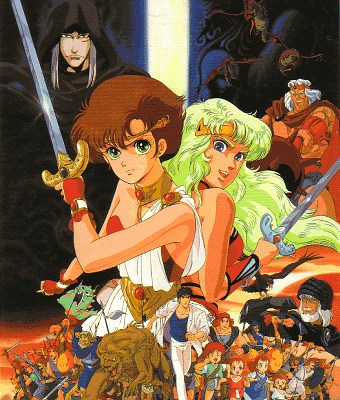
Miyako Negishi (voiced by Kyoko Fujimoto), or Neko to her friends, is a seemingly ordinary high-school girl. And we all know there are no 'ordinary' schoolgirls in anime. Sure enough Neko has secret awesome ESP powers while her sharp-dressed would-be boyfriend Haruka (Kazuhiko Inoue) has the power of teleportation. They soon discover new kid in school Keichiro (Masamichi Sato) can transform into an Aslan-style magical golden lion. On the night of a full moon our unorthodox trio are transported to the mystical kingdom of Naka no Kuni. Here silver-haired, purple-clad prophet Ladin (Nachi Nozawa) promptly proclaims Neko the reincarnation of their 500-year old queen Neryura. Aided by her super-powered friends and newfound army led by fanatical pink-haired archer Towado (Bin Shimada) she rallies the people against the evil forces of muscular Conan-esque warrior-king Altieri. Thereafter Neko duels with scantily-clad Princess Dimida (Fumi Hirano) who goes from rival to stalwart friend and ally. As the good guys march on Castle Kamura, tyrannical king Duran III has a nasty surprise in store.
Another charming relic from anime's golden age, Tobira no Akete (Please Open the Door) shares some similarities with the excellent Leda: Fantastic Adventures of Yohko (1985). As in that SF meets sword and sorcery yarn here another schoolgirl with romantic problems in the real world arrives in a fantasy realm where her psychological issues manifest as monsters and super-villains for her to fight. In the Nineties animators recycled the teens-trapped-in-a-fantasy-realm premise for a whole host of fan-favourite serials, from Magic Knight Rayearth (1994) and El Hazard: The Magnificent World (1995) to Fushigi Yugi: The Mysterious Play (1995), though its roots lie with The Wizard of Oz (1939). Please Open the Door adds a touch of The Lion, the Witch and the Wardrobe (2005) albeit with a cynical twist (more on that later) as well as an oh-so-Eighties stylistic flourish (Haruka dresses just like Sonny Crockett in Miami Vice while Keichiro sports the same puffy jacket as Marty McFly in Back to the Future (1985)) and a psychic heroine very much in vogue in the decade that spawned The Aimed School (1981) and hit manga Mai the Psychic Girl (at one stage intended as a vehicle for Winona Ryder directed by Tsui Hark for producer Francis Ford Coppola!) So basically psychic schoolgirls were huge in Japan during the Eighties.
The anime was adapted from a novel by Motoko Arai, a popular if somewhat controversial science fiction writer. Her best known work remains Green Requiem which was adapted into a live-action movie in 1985. Arai first gained notoriety after submitting a short story to a competition judged by the three most renowned science fiction authors in Japan. While Yasatuka Tsutsui and Sakyo Komatsu, author of The Submersion of Japan (1973) and E.S.P-Y (1975) and co-director of Sayonara Jupiter (1983), were unimpressed fellow writer Shinichi Hoshi singled her work out for praise. It emerged later that Hoshi was a close friend of Arai's father. Thereafter Arai's enduring popularity among young readers was tempered by suspicion over her many awards and publishing deals.
Nevertheless, the breathlessly paced Please Open the Door is a genuine charmer, full of eye-catching visuals, likeable characters and consistently engaging ideas. The script starts initially as typical Eighties anime madness. It flings both viewers and our clueless heroes into a complex fantasy saga each barely understand and feeds small nourishing chunks of plot information while keeping them on the run. Beautiful production design transcends limited animation to weave some evocative fantasy set-pieces including a great sequence where Demida takes down a huge purple dragon. After playing by the rules of teen wish-fulfillment fantasy for the first forty minutes or so, the plot springs a succession of offbeat twists. Neko grapples with the weight of responsibility and ponders whether any of this far-fetched sword and sorcery nonsense is even real before the surprise (well, not really) villain entraps our heroes in a crazy scheme to advance civilization. Arai uses the 'open the door' metaphor to draw parallels between the situation on Naka no Kuni and the heroine's own hesitance in life. The strong, complex and faceted heroine is the anime's most notable advantage. By contrast sharp-suited city boy Haruka takes on the role more often assigned to female characters. He becomes Neko's personal cheerleader although she rebuffs his romantic advances. Although one memorable scene has Neko magically morph her cuddly toy dinosaur into a Godzilla-sized menace to fend off Duran III's fearsome Black Knights, the film pulls off a delicate balancing act between kitsch comedy and disarming drama. Indeed the denouement, wherein the heroes realize they have been manipulated much the same as Japan's military dictatorship in the Forties sacrificed a generation of young people to create a Pacific Empire, is surprisingly powerful. Given the perky schoolgirl was very much the emblem of Eighties boom time Japan the final confrontation is arguably somewhat symbolic.