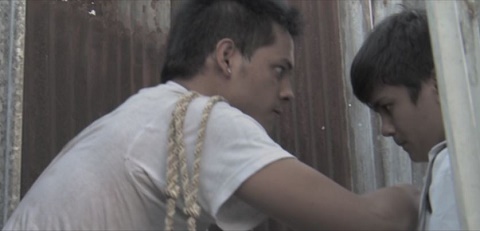
814 people have been murdered by vigilante death squads in the Philippines in the past decade, and the state not only turns a blind eye to these crimes, but may be sanctioning them as well, because the general public wish the authorities to take a zero tolerance approach to lawbreaking. In this city by the coast, teenage Richard (Felix Roco) is struggling to get by, he owes some very threatening gang members a lot of money and he is trying to drum up the cash lest he be forced to leave for good, in spite of his family being there. He tries to encourage his younger brother Raymond (Daniel Medrana) to attend school, but he cannot set an example, and their father is no help either…
Director Pepe Diokno was only twenty-one years of age when he made this exposé of the Filippino death squads, and if nothing else what he achieved was very impressive indeed, purely on a technical level. Aside for a handful of establishing shots at the beginning and a short coda, it was edited to make it appear as if the entire film had been shot in two takes, both lasting around half an hour each, making up a film that was a brief, swift hour in duration. The cut between the two takes was between the daytime scenes and the nighttime scenes, so you wouldn’t feel the need to try and identify any hidden transition and grow too distracted from the narrative.
The camerawork was entirely handheld, which lent a woozy, swaying appearance to the film, but also had the downside of making it difficult to perceive what was happening in some scenes, especially in the latter stages when there was a lot of action – running about, characters getting beaten up, and so forth – and the darkness had fallen, leaving the digital video photography rather indistinct. The anonymous city this took place in was actually a succession of elaborate sets, though tended to look pretty samey as the characters wandered their way around Diokno’s version of a Filippino slum, a vivid mess of chaotic sounds and visuals that somehow convinced as a genuine location.
As for those characters, we were patently intended to sympathise with Richard who has gotten in way over his head with the ne’erdowells, and the plotline closed down every avenue of escape as he plans to flee the city with his girlfriend Jenny-Jane (Eda Nolan), but forthright and aggressively bumptious gang member Tomas (Zyrus Desamparado), who harbours a definitely unrequited crush on her, is determined to prevent them going. This led to a cat and mouse situation around those narrow streets, if you could call something so makeshift a street, where you were simply waiting for events to erupt into violence, as expected by the opening captions concerning those victims of the vigilantes.
Although it did last such a skimpy amount of time for a feature, more like a beefed up short film really, Clash, or Engkwentro as it was originally named, quite a fair amount was packed in, much of it of a social conscience variety. We were invited not only to fret for Richard and Jenny-Jane but for Raymond as well, seeing that his brother’s downward spiral (in one so young, as well) is something that he will likely suffer too. This was not a film to supply solutions to the issues brought up, it was more highlighting the problems and expecting something to be done about them as a result of their endeavours to bring them to the public awareness, and as far as that went it was effective, though we didn’t get to know anyone here so much in depth as in sketches of their personalities and dilemmas. With the mayor’s voice (supplied by Celso Ad. Castillo, also glimpsed in mock news footage) constantly proclaiming his supposedly benevolent overseeing over a tannoy, this was a world very close to a nightmare.