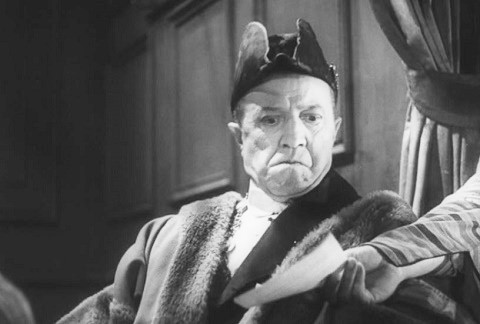
Mayor Handley (Tommy Handley) arrives at the town hall of Foaming-at-the-Mouth in a street cleaner and is met at the door by various officials who are not impressed with the way he behaves in office, but he brushes them off with excuses and marches inside to his chambers. Here he tries to balance the books of the town’s finances with the assistance of an abacus and a stick of chalk he uses to write his sums on the walls, but it would seem he is struggling with the numbers, not good when he is ordered in to explain himself to the council. Not only are they threatening to oust him from his job, but if he doesn’t come up with the missing thousands of pounds they will have him arrested. But all is not lost – he’s won a theatre in a poker game!
The fact that Handley sees this as a grand opportunity is indicative of the persona he was using in this vintage British comedy film, but more than that it was a big screen adaptation of one of the most popular radio programmes of all time, It’s That Man Again, or ITMA as it was often abbreviated to. Although largely forgotten today by all but the most dedicated comedy buffs, it holds a special place in British history as the show that practically got the nation through the war years, and the austerity that was imposed on it thereafter. Finishing in 1949 when its star died suddenly, it started in 1939, as the Second World War was commencing, and the man in the title referred to Adolf Hitler, taken from a newspaper headline when the Brits were getting royally sick of hearing about him in the news every day.
If they were sick of him then, imagine how they felt in 1943 when this spin-off was crafted from a script by the radio series’ regular writer Ted Kavanagh. This may be why the war was barely mentioned here at all, with only a few quips in reference to it, and the character of a soldier featuring later on, plus the theatre Handley has won has huge bomb damage, as you might expect from a location in the Blitz-hit capital. But mostly this was a “putting on a show” comedy as was the trend for musical hall and indeed radio entertainers to turn up in when asked to make their own films; Arthur Askey was probably the biggest rival to Handley at this time, but with the cast of ITMA characters appearing this was closer to a Crazy Gang outing.
More recent followers of comedy trends may recall the nineties series The Fast Show, which owed a lot to the humour of ITMA, and even depicted a Handley-esque comic called Arthur “Where’s Me Washboard” Atkinson whose routines consisted of a string of catchphrases the theatre audience would roar with laughter at. This wasn’t some invention of Paul Whitehouse, who played the character, ITMA really does sound to modern ears like a succession of random, repeated phrases that divorced from their historical context make it baffling as to why the audience are finding them so funny, yet lines like “Don’t forget the diver!” and “Shall I do you now, sir?” became common parlance during the nineteen-forties and lifted the public’s mood thanks to a shared sense of humour.
The film was not quite as alienating to the twenty-first century audience as its source, though there were parts which didn’t endure down the passing of time. But if you approached it as a British predecessor to the Hollywood cult comedy Hellzapoppin' then you would have some idea of what to expect, with Handley demonstrating his dazzling ability with wordplay, reeling off the puns at a dizzying rate. As well as the radio cast, a proper British film star of the day appeared in the shape of Greta Gynt, the Norwegian-born blonde bombshell of the forties and fifties, only here for some reason as a brunette, and she proved game as she joined in with the irreverent almost to a fault mayhem. Anarchic was the word to apply here, with the show they manage to get off the ground for the finale surprisingly hilarious in its throwing in everything but the kitchen sink style of laughs; before that it was patchily amusing, but engaging enough. As a record of a comedy phenomenon – twenty-two million listeners, as the titles proclaim – this was invaluable. Music by Hans May.
[Network's DVD in its British Film range is nicely restored and has two galleries as extras. Watch the merchandising one before you see the film, as it features postcards illustrating all those catchphrases, which is a neat primer for getting the jokes.]