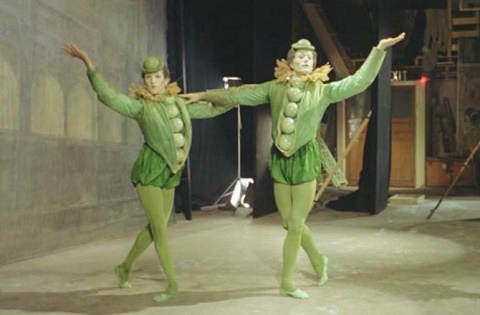
Hans Christian Andersen (Murray Melvin) is upset because his carefully written stories are being scattered to the four winds while he travels over London in his flying trunk, so when he lands he is keen to gather up the pages. However, they tumble across the streets and he is at a loss for what to do next until he realises he can make a new story up from what he sees around him in the modern capital, and merely by taking a look in through a nearby kitchen window he can be inspired. Inside, a mother and her three young children are rushing around, preparing to go out for the afternoon, and when they do the objects in the room – pots and pans, the kettle, the crockery, even the matches for the stove – become animated and start to chat.
Stories from a Flying Trunk was an adaptation of three Andersen tales in a highly eccentric fashion; it was the brainchild of the team behind the Royal Ballet’s version of Tales of Beatrix Potter from a short time before and that had been enough of a success to bring about a follow-up, this time concocted from the famed Danish author’s work. The dancers were back for this, but only in the final story, as the creative force propelling the film was Christine Edzard and she had some singular ideas about how to update the nineteenth century material for a more modern audience as the nineteen-seventies moved inexorably into the eighties. Which in effect had a lot of stop motion animation for the first and third parts, and outright surrealism for the middle one.
That initial segment had dance in it, certainly, only the dancer was a plastic bag on the kitchen table which might not be everyone’s idea of what they had in mind for a ballet for the family. The objects constantly chattered and bickered, even to the point of confusion about what was supposed to be going on as we were treated to flashbacks about, say, the sugar bowl that claimed to have been damaged during battle in Empire-era India, but then has that recollection undercut by a counterclaim that he was actually dented by a croquet ball in Edwardian times. Meanwhile the matches tell the assembled throng about what a nightmare it was for their manufacture, the agony of starting as a tree that was sawn up into smaller pieces until it was in tiny enough bits for a box of matchsticks.
If that sounds nightmarish in itself, it’s worth remembering that Edzard’s Beatrix Potter movie had been pretty creepy to watch too, but it came across like The Railway Children in comparison with the unsettling nature of this Andersen jaunt. Take the second section, an adaptation of The Little Match Girl which depicted the character as a young Indian-British child (Tasneem Maqsood) sent out to buy a box of said matches on a winter’s evening and finding on her way home that she is diverted by Londoners wanting to borrow a light, and eventually she starts using them herself to enter a magical, parallel city where she meets the Queen (actually a statue that comes to life disturbingly) and sees a parade of toy soldiers march by. She seems to be lost, and it’s a cold night, so what happens in the source happens to her as well.
A scene that is all the more disquieting for being portrayed in such an offhand manner. After that, we were back to the animation, as a little would-be ballerina (Johanna Sonnex) is encouraged after a bad ballet class to use her imagination by Andersen, who keeps popping up like some weird, trickster phantom. This is translated into envisaging a collection of vegetables travelling down the streets in a protest (with banners) to Covent Garden, demanding they put on a show there, which they do after a lot of rehearsal. That rehearsal was shown as the animated vegetables were made to throw shapes, and the actual production saw them replaced by those Royal Ballet performers who were dressed as the vegetables. If by this point you’re wondering what the hell kind of film this is, then imagine what it’s like to watch, with little to latch onto as conventional storytelling and a demented approach to refashioning the Andersen material with a curiously socialist bent: the kitchen basket rants like a Speaker’s Corner Marxist, and the vegetables (flowers in the original) are clamouring for equality to perform to Rossini. It certainly wasn’t boring, but whether it was entertaining depended on your tolerance for the downright bizarre.
[If you recall this one from childhood, you'll want to get Network's DVD, which has an excellent print and the trailer and a gallery as extras.]