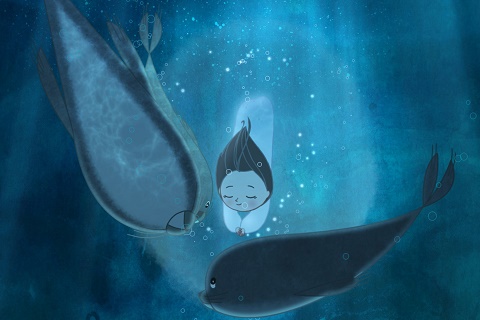
One night when Ben (voiced by David Rawle) was younger than he is now, and he’s still a child so it was only six years ago, he was living with his parents in their lighthouse home off the coast of Ireland and it being the evening, it was time for his bed. He had been painting pictures on the wall intended for his as-yet unborn baby sister, and he was particularly impressed with the selkie his mother Bronagh (Lisa Hannigan) had helped him with, a selkie being a figure of folklore which could transform from human to seal form depending on whether it was in the water or not. But as his mother tucked Ben in and gave him a flute made from a seashell, she winced in pain: she was in labour and the birth was not going to be happy…
Song of the Sea was the second of writer and director Tomm Moore’s modernised folk tales after The Secret of the Kells, and if anything was an even bigger success, eventually securing an Oscar nomination for Best Animated Feature; not that it won, but merely being up for the award was enough to raise its profile significantly and reach more audiences than it might not have done otherwise. It was selkies he was concerned with here, those Scottish myths from the far North West whose renown had reached Ireland millennia ago, and whose origins are lost in the mists of time, but melding the ancient and the modern was the style here, or at least the nineteen-eighties as far as the present day was intended to represent.
Moore was harking back to his own childhood for the trappings of his tale, hence the era Ben and his sister Saoirse (Lucy O'Connell) are having their adventure in, but childhood was not necessarily the theme, that was actually more to do with grief when the kids lose their mother when she is giving birth to the girl. Initially we are not told the exact details, and find out later this was because Moore was building up to them to get us used to the more fantastical elements which start small until they have completely dominated the narrative by the very end. Interestingly, the fantasy was instrumental in helping the characters come to terms with their losses – and that included the more outlandish individuals who populated the latter stages.
After the introduction establishes the family dynamic, which saw the father Conor (Brendan Gleeson) doting but distant and Ben frequently annoyed with his sibling who still does not speak, the grandmother (Fionnula Flanagan) makes her presence felt and that presence is wishing to take the children away from what she regards as a dangerous location to the city where she believes they would be safer. One incident with Saoirse almost drowning in the sea later, and she gets her wish, but the kids hate her for it, not least because they are leaving their beloved dog behind, so we are intended to view the grandmother as a bad influence even if you might think from a more measured perspective she had a very good point.
Yet that was part of the mixed feelings we were apparently meant to have about each of the characters, for while they could behave selfishly or manipulatively, even the most apparently callous behaviour would have us understanding their reasons, and those came from emotional pain. Ben, for instance, shouts at his sister and misbehaves because he misses his mother, so while he can act without thinking of the consequences of his actions, we would like to think by the time the finale has arrived he has learnt a lesson about life and how to cope with its ups and downs. That he has done this by taking part in a journey back to the lighthouse home was very much part of the journey narrative of many a fantasy story, which did render Song of the Sea overfamiliar in its plot details even if the emotions were deeply felt, though the animation was refreshingly faithful to a European appearance, meaning it was distinctive enough to stand alone. Some people were in tears by the end of this; if you were not, maybe it was because you could tell where it was going and how it was tugging the heartstrings. Music by Bruno Coulais.