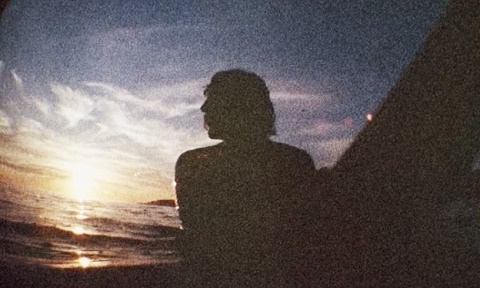
George Greenough is a dedicated surfer here to tell us of the benefits of the pastime, which for him has become not only a way of life, but his whole life. He is an American who moved to Australia because he believed the surfing was better and less crowded on those beaches, but to finance this he is also an inventor. Cameras are his speciality, especially underwater cameras for capturing scenes of the sea, and he has assisted in a number of productions, including his own such as this one, sought all over the world for the high quality of the footage he is able to secure. Now he plans to preserve the greatest wave clips ever seen…
Crystal Voyager is a film so inextricably linked with the sport of surfing that you imagine it would be a tough sell to anyone who has never tried it, yet there was a case to be made for watching it purely as an exercise in documentary, and as it reached its final twenty-five minutes something grasping for the cosmic. Naturally, seeing as how that sequence was scored to the strains of Pink Floyd’s Echoes, the audience of not simply fans of that band but stoner fans of that band found this a must-see as well, and the Floyd would show extracts of that finale to accompany their concerts in the nineteen-seventies which presumably left the audience with their minds suitably blown, such was the excellence of the imagery.
That said, it did seem like a bit of a slog to get there as Greenough insisted on narrating his own tale of how he built not only his camera equipment, but entire boats to take him out to the most isolated areas of the coast where he could surf in peace (bizarrely, not on a full length board but on a smaller one, presumably for its potential velocity through the water). This became the film’s running theme, the subject determined with single-minded obsession to leave civilisation behind and get out to a life on the ocean wave untroubled by the sight of anyone else, sustaining an existence of perfect solitude, just him and the sea and the wildlife he would see along the way. Fair enough, he did have a couple of friends with him.
But it remained that notion of becoming one with the waves, the tubes that they formed and he would be propelled through, that saw Greenough at his most content. His voice some have described as hard to listen to, making it a relief when Pink Floyd eventually dominated on the soundtrack, but though he did drone on somewhat, funnily enough it suited the mood of the movie, and he did come out with some interesting nuggets of information, some of it more odd than others. His adventures in filming for television and film were touched on, as we watched him secure footage for a weird-sounding effort where the bad guy is a surfer toting a waterproof machine gun, with George his stunt double.
Precisely what this was, was left frustratingly unnamed, as it might have been amusing to watch an armed surfer riding the waves, but it was really the fruits of Greenough’s labours with his cameras that we were here for, and after a rambling stretch of documentary with no sound recorded, just the narration and some very variable country rock, we were rewarded with truly mesmerising sights of the ocean and extreme closeups of exactly what it would be like to be a wave as it tumbled and crashed around the sea. Resembling a surfer’s impression of watching the star gate sequence of 2001: A Space Odyssey, it was very easy to grow lost in the imagery as the screen is filled with a seemingly endless succession of spinning H2O, with the British band noodling immersively over it, which was why so many audiences felt the need to turn up the escapism factor as far as it would go by adding their own mind-altering substances to enhance the experience. But you didn’t really need that to appreciate Crystal Voyager, merely a sympathy for seventies head movies even if you’d never been under the influence in your life.