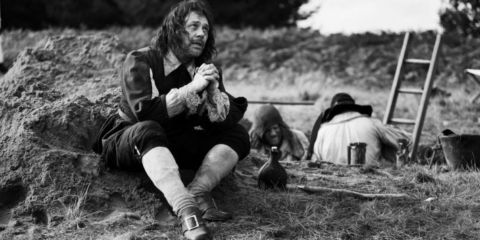
The English Civil War is raging, but for the astrologer and servant of a nobleman Whitehead (Reece Shearsmith) the imperative is to get away from the fighting. He does this for two reasons: one, he does not wish to be killed on the battlefield, and two, he has a mission to carry out that his master has ordered him to do, which takes the form of a search for a missing alchemist named O'Neil (Michael Smiley). To tell the truth, he really has little idea of how he will do so, and with the muskets firing and cannonballs landing there's more a case for survival than anything else...
A Field in England was notable for its distribution, as the producers opted to release it to a number of platforms all at once. Therefore on Friday the fifth of June 2013 in the United Kingdom you had the choice of going to see this at the cinema, buying or renting it on the disc format of your choice, watching it online or if you fancied it for free you could watch it that evening on television, on the production company's Film4 channel. Whether this was a wise move was a moot point, especially when the reaction had started to come in: while the critics had raved about it, the general reaction among the public was "Huh?"
That was mostly down to the style, and director Ben Wheatley with his writer Amy Jump's desire to make the old adage about the past being another country where they do things differently as blatant as possible. Therefore it was a deliberately alienating film, crafting a sense of a time gone by which would be very hard to relate to in the modern world of centuries later, a brave move but it did leave those who caught it on television thankful that they didn't pay to see it. It could have been a case of the audience being stung by so much hype - Wheatley seen as a bright new hope of British film.
Or it could have been a case of a lot of viewers pissed off that the movie they were experiencing was not going to play ball, and that very prickliness in being even basically understandable without a lot of work on the part of the audience was turning most of them off. This was less a crowd pleaser - far less - and more an art film, which many will resist, and when they were expecting a Civil War tale with a twist, it was evidently a twist too far as scene after scene of hard to fathom plot and densely written and delivered dialogue passed by, leading a lot more than one person to grow irritated, and even give up on the film as a lost cause. In a way, this was a pity since it was so ambitious on such a low budget.
And that kind of ambition should be encouraged, there's nothing wrong with pushing the right boundaries in your storytelling; then again, it's perhaps not so admirable when the results are incomprehesible to all but yourself and you run the risk of those dreaded terms, "pretentious" and "self-indulgent". As Whitehead and the three soldiers he picks up along the way seek the nearest alehouse (yes, this is a yarn about some blokes delayed on the way to the pub), he is more intent on finding O'Neil, yet it may be the case that O'Neil is seeking him instead as he has been studying divination and the ne'erdowell believes this means he can track down the particular treasure he wants to get his hands on, buried somewhere in that, yes, field in England. This plays out with lots of swearing (did they really curse that much in those times?), some magic mushrooms (because it just wasn't obscure enough without a tripping sequence), and eventual murder, all filmed in flat black and white which should have been a lot more gleaming. Interesting, then, but not all that entertaining. Music by James Williams.




 Display comments