A smirking, silver-haired outlaw (Corrado Pani) escapes the hangman’s noose when his allies, some Mexican banditos shoot up the town, killing almost everyone in sight. Confronted by the vengeful widow (Mirella Pamphili) of a man he killed, the outlaw charms her into committing suicide instead (!), then brutally guns down his Mexican friends. “Howdy, folks! My name is Bart”, he cheerfully announces via some unexpected narration before informing us his daddy taught him “money is everything” and “like ripe fruit on the tree. All you have to do is reach out and grab it.”
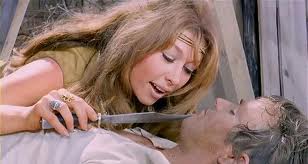
Bart meets up with his cohorts, Ted (Antonio Sales) and Phil (Luis Dávila), and they ride into a seriously creepy ghost town. Here they are joined by Mary (Claudia Gravy), a sultry if anachronistic hippie chick looking chic in her headband, bucksin fringe and hotpants. Yes, hotpants. In a western. God bless, those Italians. Mary is Phil’s girl but her flirty ways stir lust in tormented Ted. Our eccentric outlaws rob a stagecoach, slaughtering its passengers and a cavalry escort, but during the shootout Bart unexpectedly bites a bullet. With only three of them left, Phil hides the gold while Mary seductively plays the two men off each other, working for an unseen party secretly watching them all. The sadistic fun and games escalate after the trio find a hostages in Gertrude Benson (Ana Maria Noé), an embittered old woman living in a cobwebbed mansion and Bridget (Ana Maria Mendoza), a young pioneer woman who stumbles into town in the wake of an accident that has killed her family. Also arriving in town and arousing the ire of the outlaws is Ray (Lou Castel), a dazed, delirious and dehydrated young hero riding a super-intelligent horse and armed with a sack full of boomerangs. Yes, boomerangs. Are you with me so far?
Matalo! is arguably the strangest spaghetti western ever made, which is saying something when one factors the likes of Keoma (1976), Django Kill! (1967) and Kid - Terror of the West (1973) into the equation. But no, Matalo! takes first prize. It was actually a remake of an even more obscure Italian western called Kill the Wickeds (1967), but Milan-based, independent auteur Cesare Canevari reworks a fairly standard scenario (outlaws fall out over stolen gold) into a psychedelic mood piece that attempts to revitalise the western with elements from then-contemporary youth culture. Hence, outlaws styled like the Rolling Stones, an antiheroine who comes across like Anita Pallenberg out West, and a pacifist hero who shuns gold and would rather whack villains with his boomerang than fill ’em full of lead.
Having already played one of the most memorable spaghetti western antiheroes in Damiano Damiani’s terrific, politically-charged A Bullet for the General (1968), Euro-exploitation stalwart Lou Castel cuts a curious figure here, with his pasty face and paisley jacket, quite unlike the conventional cowboy heroes essayed by Clint Eastwood or Franco Nero. So enigmatic he makes the Man with No Name look like Chris Tucker, Ray only enters the film after forty minutes and thereafter spends most of his screentime whimpering for mercy whilst tortured and abused. The performances, particularly those of Corrado Pani and super-sultry Spanish sexpot Claudia Gravy - whose hippie harlot is so intriguing, one wonders why no Italian producer considered making a spaghetti western Barbarella (1967) - create vivid characters, even though the script ensures they remain ciphers, second fiddle to Canevari’s restless audio-visual experimentation.
While the quirky style does not quite cover some sloppy storytelling, Canevari rearranges a well-worn plot into a genuinely compelling and stimulating, jigsaw-like fable layered with subliminal imagery, astonishing camerawork (at several points the camera does a complete 360 degree spin) and an amazing soundtrack by Mario Migliardi that stands as this film’s crowning glory. It is a fascinating aural tapestry, interwoven with the film, combining ghostly whispers, Hendrix like fuzz guitar and ambient, borderline sci-fi soundscapes in an audacious manner anticipating Dario Argento and Goblin’s work on Suspiria (1977). A crescendo is reached with a lengthy, jaw-dropping sequence wherein Ray is savagely chain-whipped in super-slow-motion until his horse clobbers Ted to a bloody pulp. A scene both surreal, silly and poetic yet as oddly innocent as a vintage Roy Rogers serial.
An eclectic exploitation filmmaker, Canevari’s back catalogue included such choice items as I Emmanuelle (1969), an early take on the erotic heroine with Erika Blanc in the role that brought Sylvia Kristel such infamy a decade later, The Nude Princess (1975) a bizarre political satire-cum-sexploitation romp starring transsexual Ajita Wilson, and the tasteless The Gestapo’s Last Orgy (1977) wherein S.S. Officers enjoy a cannibal dinner of roast babies. He came across as a filmmaker out to layer his schlock output with Serious Social Statements, even though the viewer is left somewhat uncertain as to what those might be. The most popular interpretation posits Matalo! as an allegory about capitalism and the hippie movement’s disenchantment with materialistic society, given the plot develops into a battle between opposing figures for Ray’s soul. However, this twist arises so late in the day it is almost an afterthought. For the most part, the film functions best as a fever dream, hinting at broader ideas amidst a psychedelic delirium of potent political and psychosexual metaphors.
That music never stopped, did it? I'd hate to think what this would be like without it. I suppose this is what you'd call an acid Western, though the effect is relentlessly woozy, as if the cast were about to stagger out of shot (with good reason, in some cases). Loses marks for not appearing to be very interested in the genre at all, but it spins a dazed spell. Also, the old woman didn't half look like David Attenborough.




 Display comments