| |
For a picture that was designed to portray the ultimate hetero male sexual fantasy of attractive women throwing themselves at you at every turn, there was something curious about What's New Pussycat, almost as if the reality of a fantasy was not all it was cracked up to be. Was this the influence of the project's initiator, film star and lothario Warren Beatty? Was this in fact a cry for help for one of the most prolific shaggers in the movie business? If it was, he was still struggling to cope with his libido for decades afterwards, until Annette Bening managed to tame that rampant attitude to the female of the species.
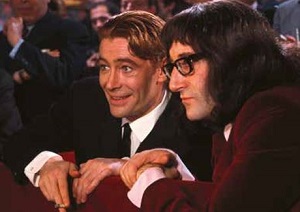 But Beatty wasn't in What's New Pussycat, was he? According to him, he made so many demands on his very own star vehicle, tailor made for him to the extent of using his telephone greeting as a title, that producer Charles K. Feldman and company simply told him to forget it and they would carry on without him. Beatty thought he was an essential component part, it was based on his life after all, but nope, off he went to pastures new, though as those pastures included all-time classic Bonnie and Clyde, he really did not have very much to complain about. Meanwhile, Peter O'Toole stepped into his cinematic shoes. But Beatty wasn't in What's New Pussycat, was he? According to him, he made so many demands on his very own star vehicle, tailor made for him to the extent of using his telephone greeting as a title, that producer Charles K. Feldman and company simply told him to forget it and they would carry on without him. Beatty thought he was an essential component part, it was based on his life after all, but nope, off he went to pastures new, though as those pastures included all-time classic Bonnie and Clyde, he really did not have very much to complain about. Meanwhile, Peter O'Toole stepped into his cinematic shoes.
The plot, if you could discern it from something this self-consciously chaotic, saw O'Toole as Michael James, the editor of a women's fashion magazine in Paris where he is suffering, oh how he is suffering, from too many beautiful ladies throwing themselves at him, and he is naturally unable to turn them down. This is an issue because he really wants to settle down with his girlfriend Romy Schneider, who wishes him to marry her, but how can he when he is in such a torment of being unable to turn down sex from all the other women he encounters? What do you mean, you have no sympathy for him?
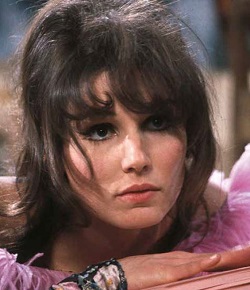 That part of the film was certainly thanks to Beatty's early influence, but the rest of it was a different matter. Former stand-up comedian turned scriptwriter and gagman Woody Allen was recruited to pen the screenplay, and if you know he has essentially spent the decades in therapy, voluntarily, it will not surprise you to learn he introduced the concept of psychiatry to this, reasoning that if talking cures to help him with his problems were valid in his life, then maybe he could explore that for the rest of his screen debut too. That's right, he was cast in What's New Pussycat, though not as anyone especially important to the events. That part of the film was certainly thanks to Beatty's early influence, but the rest of it was a different matter. Former stand-up comedian turned scriptwriter and gagman Woody Allen was recruited to pen the screenplay, and if you know he has essentially spent the decades in therapy, voluntarily, it will not surprise you to learn he introduced the concept of psychiatry to this, reasoning that if talking cures to help him with his problems were valid in his life, then maybe he could explore that for the rest of his screen debut too. That's right, he was cast in What's New Pussycat, though not as anyone especially important to the events.
An O'Toole/Allen double act might have been intriguing, but barely got off the starting blocks in the movie itself as they shared a minimum of scenes together, apparently because Feldman was obsessed with cramming as many lovely actresses into this as possible, thus leaving the men somewhat at a disadvantage. Given Allen was writing this, you might have expected him to give himself all the best jokes, but it was not to be thanks to another star in the cast: Peter Sellers, then on the rise internationally as the sixties was his heyday, and he was not about to play second fiddle to anybody else here.
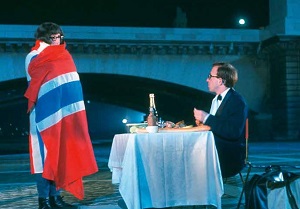 Therefore Sellers made sure he was the focus by nicking all the best material for his own psychiatrist character, and if that material was not forthcoming, he merely improvised his own, his professional jealousy for Allen not a secret, particularly when they kept getting mistaken for one another - presumably all bespectacled Jewish comics looked the same to people back in the sixties. That was why Sellers sported a long, black wig throughout, so he would be distinctive enough in appearance from Allen to make his mark in yet another of those all-star comedy marathons that peppered this era's blockbusters (and would-be blockbusters). Therefore Sellers made sure he was the focus by nicking all the best material for his own psychiatrist character, and if that material was not forthcoming, he merely improvised his own, his professional jealousy for Allen not a secret, particularly when they kept getting mistaken for one another - presumably all bespectacled Jewish comics looked the same to people back in the sixties. That was why Sellers sported a long, black wig throughout, so he would be distinctive enough in appearance from Allen to make his mark in yet another of those all-star comedy marathons that peppered this era's blockbusters (and would-be blockbusters).
Yet no matter how much fun everyone involved wanted us to believe they were having, psychiatry cast a long shadow over What's New Pussycat. Allen's troubles were very public, whether you believe he was in the wrong or a victim of a hate campaign, it's difficult to separate him from the scandals at this remove. Sellers was notoriously unstable mentally, O'Toole was a raging alcoholic, Schneider was so fragile she committed suicide, as did the elegant Capucine, and Paula Prentiss nearly killed herself on the set of this, forcing her to take a break from acting for a while, ironic when her character's running joke is her suicide attempts. It was a goofy, wacky film, but there was desperation to it, uncertainty that this was the path to fulfilment or ephemeral at best, damning to terminal dissatisfaction at worst. Maybe that's why it retains its cult following to this day - its finest legacy probably Burt Bacharach and Hal David's catchy songs.
[Eureka's Blu-ray has an audio commentary, booklet and subtitles as extra features.]
 |


