| |
1970 was an odd year for British cinema in that censorship was relaxed, allowing far more freedom than ever before, but you had the impression that with all these possibilities filmmakers were not entirely sure what to do with them. Or rather, they had some strong ideas, but the medium had not tackled such issues as sex and violence so blatantly before, and it was still feeling its way to the best way of using these to drag the punters into their local fleapits. It's not original to point out that the seventies were a decade of gradual but vertiginous decline for the British film industry, but it is true, though the most visible studio there, Hammer, gave it a darn good go at thriving.
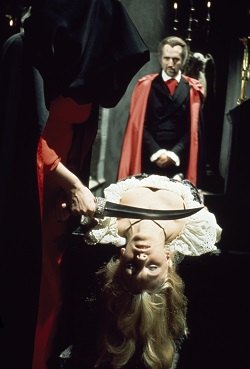 Their throat-clearing entry into the world of that increased graphic content was The Vampire Lovers, an adaptation of 19th century writer J. Sheridan Le Fanu's novella Carmilla, a tale of a bloodsucking young lady which it quickly became clear had been snapped up not because it was a classy chiller from the Dracula era, though that was doubtless part of it, but because they could apply a hefty dose of young ladies taking their clothes off with an abandon never dreamt of before in mainstream film. That they were nubile lesbians into the bargain added precisely the right air of prurience to the project, despite it starring that impeccable gentleman Peter Cushing. Their throat-clearing entry into the world of that increased graphic content was The Vampire Lovers, an adaptation of 19th century writer J. Sheridan Le Fanu's novella Carmilla, a tale of a bloodsucking young lady which it quickly became clear had been snapped up not because it was a classy chiller from the Dracula era, though that was doubtless part of it, but because they could apply a hefty dose of young ladies taking their clothes off with an abandon never dreamt of before in mainstream film. That they were nubile lesbians into the bargain added precisely the right air of prurience to the project, despite it starring that impeccable gentleman Peter Cushing.
Keen for more, the Carmilla films became a trilogy by and by, with the antiheroine adopting anagrams of her name: in Lust for a Vampire, she was Mircalla, in Twins of Evil, she was Mircalla, though sadly we did not get a quartet where she would be called Lciamrla or something. She never shared a love of crosswords, either, but she must have been a fan. The third effort was by far the best, a stark slice of Gothic, but the middle part has gone onto garner a camp reputation that Hammer were usually a shade too stuffy embrace, therefore any humour here was largely of the unintentional variety since everyone on screen was taking this fluff so seriously.
Behind the scenes may have been a different story, but the cast were not required to do much hooting and hollering and arching of eyebrows, not as much as the audience were at any rate. The story had it that Carmilla was resurrected in the first act by DJ Mike Raven (he was a DJ in real life, not in the plot, it wasn't that camp) who not only suffered the indignity of having his lisping tones dubbed by Valentine Dyall, but had his eyes dubbed by Christopher Lee, using old footage. Anyway, he pours a maiden's freshly-collected blood over the corpse of our girl, and before you know it one of the most celebrated horror movie photos of the era was created.
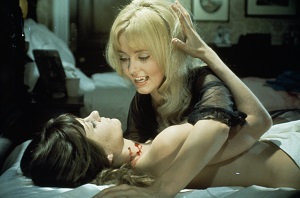 That was of the star, Yutte Stensgaard, topless and covered in blood, sitting up in her coffin, a shot that was sort of in the film, but the censors were still not so lenient, so the image was fogged in a dream sequence to cover the offending parts. Stensgaard was a Danish starlet who tried her hand in most glamour roles, as well as gameshow hostess and decorative gigs, while in Britain but would give up the acting life soon after, moving to the United States and becoming involved with the Republican Party. Some might say playing a vampire was perfect grounding for that, but we're not here to talk politics, we're here to get to the bottom of why Lust for a Vampire endured. That was of the star, Yutte Stensgaard, topless and covered in blood, sitting up in her coffin, a shot that was sort of in the film, but the censors were still not so lenient, so the image was fogged in a dream sequence to cover the offending parts. Stensgaard was a Danish starlet who tried her hand in most glamour roles, as well as gameshow hostess and decorative gigs, while in Britain but would give up the acting life soon after, moving to the United States and becoming involved with the Republican Party. Some might say playing a vampire was perfect grounding for that, but we're not here to talk politics, we're here to get to the bottom of why Lust for a Vampire endured.
Or rather, it was not bottoms director Jimmy Sangster (a regular Hammer screenwriter trying his hand at the helm) was captivated by, as the production was most enamoured of a lady's top half. No nice way of putting it, but these 1970 horrors from the studio behaved like teenage boys who had just discovered boobs and were asking themselves, "Hey, why have we never noticed these before?! They're great!" For that reason, among others, the sexual content, while fairly tame by others' standards, renders the results looking pretty naff, though crucially not offensive as you are more probably going to laugh at what passed for the height of British eroticism.
Not least because of such lunacies as the song Strange Love playing not once but twice, once over the scene where visiting author Michael Johnson seduces Carmilla and she doesn't bite him, and then over his fever dream: but there was more, as the vampirette visibly crosses her eyes in ecstasy in these scenes, not a look that caught on. Add to that her new home of a girls' finishing school where she can feast her desires as much as she wants, Suzanna Leigh (one of a tiny amount of people who didn't like Peter Cushing, oddly) as a games mistress actually called Miss Playfair, and Ralph Bates as the headmaster who takes off his spectacles to be bitten by Carmilla.
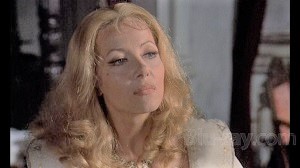 Yes, it was all very daft, but strangely endearing in that British pluck sort of way. Hammer had always featured heaving bosoms in their shockers, but 1970 represented a point when works like Lust for a Vampire and, made a few months later, Countess Dracula meant the gloves were off and they were doing whatever they could to get the customers in, so if that meant the promise of nudity, so be it. Countess Dracula was Ingrid Pitt's second Hammer after The Vampire Lovers, where she played Carmilla, but she turned down Yutte Stensgaard's role in the sequel because, well, she thought it was a load of rubbish. The Countess Bathory retelling was up her street, however. Yes, it was all very daft, but strangely endearing in that British pluck sort of way. Hammer had always featured heaving bosoms in their shockers, but 1970 represented a point when works like Lust for a Vampire and, made a few months later, Countess Dracula meant the gloves were off and they were doing whatever they could to get the customers in, so if that meant the promise of nudity, so be it. Countess Dracula was Ingrid Pitt's second Hammer after The Vampire Lovers, where she played Carmilla, but she turned down Yutte Stensgaard's role in the sequel because, well, she thought it was a load of rubbish. The Countess Bathory retelling was up her street, however.
Erzebet Bathory passed into legend as the tyrannical ruler who bathed in the blood of six hundred virgins (not six hundred all at once) since she was convinced it preserved her beauty. It's unlikely she really did this, but print the legend as they say, so Hammer saw this take as ideal to promote their newly discovered love of female stars and Pitt seemed to be perfect as something new for their output, and a genuine celebrity to boot. This didn't last, and this pair were the only results of her contract with them, but she did have an Eastern European allure that was ideal even if they didn't find anything else to do with her for follow-ups, alas.
Pitt played Countess Elisabeth, who started aged and found young, female blood revitalised her - but for a day or two at most. She should be settling down with righthand man Nigel Green, but the rejuvenation sets her hungry eyes on Sandor Eles, the younger nobleman who really should be off with heir Lesley-Anne Down, but she's been kidnapped. It was quite involved, as you can see, but the central fright, that beauty fades and fresh faces get old, was part of the cycle started by Whatever Happened to Baby Jane? where the ageing female stars found a new lease of life playing harridans and the like. The difference here was Ingrid was in her early thirties.
Although Countess Dracula cultivated an air of olden days rollicking, especially early on, it did not really take, probably thanks to the subject matter being so cruel, not that this was massively gory, it was the red stuff that provided the queasiness. It was Pitt's best showcase, or would have been had she not been dubbed - Yutte was dubbed too, it was Hammer's rather baffling standard practice for years. While the vampire in Lust for a Vampire had a feline, rather haughty beauty, Pitt's was more aggressive, so you could believe her vamping though she went about collecting blood in a different manner. Certainly both these ladies provided formative experiences of the carnal for at least two generations of young viewers staying up late to watch them on TV from the seventies to the nineties, and for that they will always be held in affection.
[Studio Canal release Lust for a Vampire on Blu-ray in a special edition, restored and looking great. Those extras in full:
Strange Love: Hammer in 1970
Script to Screen: To Love a Vampire
Judy Matheson interview (some excellent anecdotes here from one of the cast).]
 |


