| |
There was one big problem with Sidney Lumet's Cold War thriller Fail-Safe when it was released in 1964: it wasn't funny. If he and his screenwriter Walter Bernstein had adapted the novel by two professors, Eugene Burdick and Harvey Wheeler, with a lot more laughs, so the legend goes, it would have gone over with audiences a lot better. This was down to its similarities to Stanley Kubrick's Dr. Strangelove, or How I Learned to Stop Worrying and Love the Bomb, which the aforementioned academics were sued over by Peter George, who penned Red Alert, the book Kubrick and satirist Terry Southern had adapted for their hit.
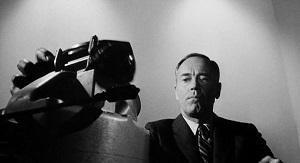 The case was settled out of court with little publicity, but the damage had been done, as certain characters and situations were simply too close in Fail-Safe to the ones in the Kubrick classic that had been released a few months before - oddly, they were both from the same studio, Columbia. This apparently meant that audiences laughed at Fail-Safe too, not because it was hilarious, but because they could not take it seriously after the other movie had posited potential Armageddon as something to make fun of, bringing in the whole of a doomed humanity to the biggest joke imaginable, with the ultimate punchline to boot. The case was settled out of court with little publicity, but the damage had been done, as certain characters and situations were simply too close in Fail-Safe to the ones in the Kubrick classic that had been released a few months before - oddly, they were both from the same studio, Columbia. This apparently meant that audiences laughed at Fail-Safe too, not because it was hilarious, but because they could not take it seriously after the other movie had posited potential Armageddon as something to make fun of, bringing in the whole of a doomed humanity to the biggest joke imaginable, with the ultimate punchline to boot.
Yet what really happened was that the audiences who did not go to see Fail-Safe simply heard its premise and thought, "You know what? Let's not bother." For there was more to the satire that put them off, it was the whole atmosphere of the world in 1964, immediately post-President Kennedy and in the midst of an election where the matter of who would invite the Four Horsemen of the Apocalypse to the White House was on everyone's minds. As it turned out, there was no atomic war as America and The Soviet Union played out their rivalries on smaller scale, though still devastating for some countries caught up, like Vietnam.
Back at Fail-Safe, had the general moviegoer not been uninterested in watching their fears play out on the silver screen in such a humourless manner, they would likely have found any laughter freezing in their throats. Yes, there were bits and pieces unavoidably summoning up memories of Peter Sellers on the hotline to Moscow, or George C. Scott willing the U.S. Government to go ahead and bomb Russia anyway since it was far preferable to admitting they were in the wrong, but Lumet managed a tone that started doomladen (a nightmare of one of the generals - played by Dan O'Herlihy) and only grew more intense from there.
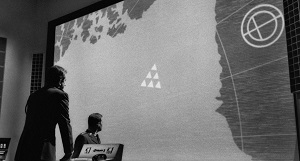 He constructed this with a sense this oncoming global tragedy was as inescapable as the walls that make up the film's war room, where the calamity is projected on a huge screen that blandly animates the inexorable march to the loss of millions of lives: the only thing President Henry Fonda can do is ensure that number is in the low millions (including his own wife) and not the high millions. He does so by ignoring hawkish advisor Walter Matthau's recommendations that now is the chance they have been waiting for, with the Soviets at their mercy it is time to start World War III, which will last mere minutes with America the victor. He constructed this with a sense this oncoming global tragedy was as inescapable as the walls that make up the film's war room, where the calamity is projected on a huge screen that blandly animates the inexorable march to the loss of millions of lives: the only thing President Henry Fonda can do is ensure that number is in the low millions (including his own wife) and not the high millions. He does so by ignoring hawkish advisor Walter Matthau's recommendations that now is the chance they have been waiting for, with the Soviets at their mercy it is time to start World War III, which will last mere minutes with America the victor.
Fail-Safe's cast was arguably a match for Dr. Strangelove's despite the desired effect being supposedly different. But was it? They both position humanity at the mercy of the machinery of war we have created: come the nineteen-eighties, when the Cold War heated up again, the thriller WarGames posited the technology as a naïve child bringing the planet to the brink of destruction, an artificial intelligence twist that looked ahead to the next century almost accidentally. But back in the sixties, it was a decidedly analogue catastrophe we were facing, where the combined mistakes of nations paranoid about one another are responsible.
Every film about nuclear war places the blame at the feet of people, either because of our stupidity or not being able to grapple sufficiently with our achievements of innovation. In Fail-Safe, it was both; though the plot mechanism could not happen in real life, as the U.S. bombers would not have enough fuel to make it to Moscow, the way human error instigates the crisis and the war machine, now activated, cannot be turned off, was disturbingly authentic. The Cuban Missile Crisis would have been on everyone's consciousness and how close nuclear conflict had been, but if anything it is the stubborn refusal of the bomber crew in this film to accept they are wrong that rings the most true, deluding themselves they are doing the right thing by slaughtering countless Russians for their country. That idiocy was what you took away from Fail-Safe, the worry that nobody is too clever for their own good, but we certainly can be too stupid for our own good.
[The Criterion Collection release this on Blu-ray with the following features:
New 4K digital restoration, with uncompressed monaural soundtrack on the Blu-ray
Audio commentary from 2000 featuring director Sidney Lumet
New interview with film critic J. Hoberman on 1960s nuclear paranoia and Cold War films
Fail Safe Revisited, a short documentary from 2000 including interviews with Lumet, screenwriter Walter Bernstein, and actor Dan O'Herlihy
PLUS: An essay by film critic Bilge Ebiri.]
 |


